 How-to
Do Lithium Batteries Need Special Chargers?
Last Updated: November 14, 2026
Quick Summary
Yes, most lithium batteries do need special chargers, so do lithium batteries need special chargers is a fair question with a mostly yes answer. A lithium charger holds the correct voltage and stops charging when the battery is full, while lead-acid chargers often do neither and may add equalization or float stages lithium cannot absorb safely.
- A 12V LiFePO4 pack typically uses a charge profile in the 14.2 to 14.6V range and should stop when full.
- Equalization and desulfation modes are for lead-acid only and must be disabled for lithium.
- Most LiFePO4 batteries block charging below freezing to protect the cells, which is normal.
- Check every charge source: converter, solar controller, onboard charger, and any DC-to-DC charger.
- A charger labeled only 12V tells you almost nothing; you need the absorption and float voltages.
Table of Contents
- Do Lithium Batteries Need a Special Charger? The Short Answer
- Can You Charge a Lithium Battery With a Normal Charger?
- Lithium vs. Lead-Acid Charging Profiles: Why the Difference Matters
- Choosing a Lithium Battery Charger 12V System: Volts, Amps, and BMS
- Do I Need a Special Charger for Lithium Batteries in My RV?
- Do Lithium Batteries Need a Special Solar Charger?
- How to Check Your Existing Charger's Specifications Before You Plug In
- Cold, Heat, and a Battery That Won't Take a Charge: Troubleshooting Real Scenarios
- Frequently Asked Questions
Do Lithium Batteries Need a Special Charger? The Short Answer
Yes, most lithium batteries need a charger matched to lithium chemistry, though a few exceptions exist.
Lithium batteries, especially LiFePO4, accept charge differently than lead-acid. They have almost no internal resistance, so they pull everything a charger gives them, and must never sit at high voltage once full.
So do lithium batteries need special chargers? For most setups, yes.
This guide covers compatibility, voltage, BMS protection, and cold-weather charging, and shows how to check your own charger before you plug in.
Can You Charge a Lithium Battery With a Normal Charger?
Sometimes, but the charger must meet strict voltage limits. A normal lead-acid charger can work if its output matches lithium specs and it stops at the right point.
Battery manufacturers generally advise that a lithium battery needs charging equipment with the correct voltage for its chemistry, and that a charger suited to the battery's chemistry is the safest choice.
The practical test comes down to three things:
- Does the charger's absorption voltage fall within the battery maker's spec?
- Does it stop charging when the battery is full?
- Does it avoid equalization and desulfation modes?
If you answered no to any of these, use a different charger. A mismatch here is the fastest way to damage an expensive bank.
Lithium vs. Lead-Acid Charging Profiles: Why the Difference Matters
A charging profile is the voltage-and-current recipe a charger follows to refill a battery. Lithium and lead-acid recipes differ at almost every stage, which is why the wrong charger causes trouble.
Constant-Current/Constant-Voltage (CC/CV) Charging Explained
CC/CV charging is the standard for lithium. The charger pushes steady current until the battery hits its voltage limit, holds that voltage while current tapers, then stops when current drops low enough.
Lead-acid chargers add stages lithium does not want: float, equalization, and desulfation. Each pushes voltage in ways a lithium battery cannot absorb safely.
For a deeper look at how these stages work, see our guide on how a lithium battery charging profile works.
Where Lead-Acid Modes Go Wrong on Lithium
Equalization is the biggest offender. It deliberately overcharges a lead-acid bank to stir its electrolyte; a lithium battery has none to stir, so the extra voltage just heats cells and triggers the BMS.
Float mode is subtler. Holding a lithium battery at high float voltage for hours adds stress without benefit, lithium wants to rest once full.
Here is the short version of what changes:
| Feature | Lead-Acid Charger | Lithium Charger |
|---|---|---|
| Charge method | Multi-stage with float | CC/CV with clean cutoff |
| Equalization | Yes, periodic | Never |
| Desulfation | Yes | Never |
| Full-charge behavior | Float voltage | Stops charging |
| Voltage tolerance | Wider | Tight |
Choosing a Lithium Battery Charger 12V System: Volts, Amps, and BMS
A lithium battery charger 12V setup must match three numbers: charge voltage, charge current, and the battery's BMS limits. Get all three right and the bank lasts for years.
Current matters too. Too high a rating overwhelms a small bank; too low takes forever and may never finish absorption.
Then there is the battery management system, or BMS, the circuit board inside the battery that protects individual cells.
A good charger works with the BMS, not against it. If the BMS keeps tripping, the charger is likely pushing too much voltage or current.
Do I Need a Special Charger for Lithium Batteries in My RV?
For most RV lithium conversions, yes.
The converter is the piece most owners forget.
Next, check the solar controller.
The onboard charger, if present, follows the same rules as a portable charger: a lithium or CC/CV mode, a clean stop when full, and no equalization.
A DC-to-DC charger from the tow vehicle is the fourth source.
Our rule of thumb: check every charge source, converter, solar controller, onboard charger, and any DC-to-DC charger.
If your RV battery keeps dying, the cause is often a charging mismatch rather than a bad battery. Our guide on why RV batteries keep dying walks through the diagnosis step by step.
Charging Setup Differences by Application
The same logic applies outside RVs, but the sources change. On a boat, the alternator, shore-power charger, and solar controller all need lithium profiles; a stock marine alternator may not be rated for lithium's low internal resistance, so a DC-to-DC charger or external regulator is often needed. In a solar system, the controller is the only source, so just confirm it has a lithium profile and its absorption voltage matches spec.
Do Lithium Batteries Need a Special Solar Charger?
Solar charging needs a charge controller set for lithium, not a different panel. The controller is the gatekeeper between the panels and the battery.
Most modern MPPT controllers include a lithium profile you select in settings. Older or fixed-profile controllers may not, and those are the ones to replace.
A lithium profile on a solar controller does three things:
- Sets the absorption voltage to the battery maker's spec
- Ends absorption cleanly with no float overcharge
- Disables equalization
For help picking the right unit, see our guide on choosing charge controllers for lithium batteries. It covers matching controller amps to panel wattage and battery size.
How to Check Your Existing Charger's Specifications Before You Plug In
Before you connect anything, verify the charger's output against the battery's spec sheet. This five-minute check prevents most compatibility failures, but only if you know which numbers to look for and how to interpret them.
Where to Find the Charger's Real Output Specs
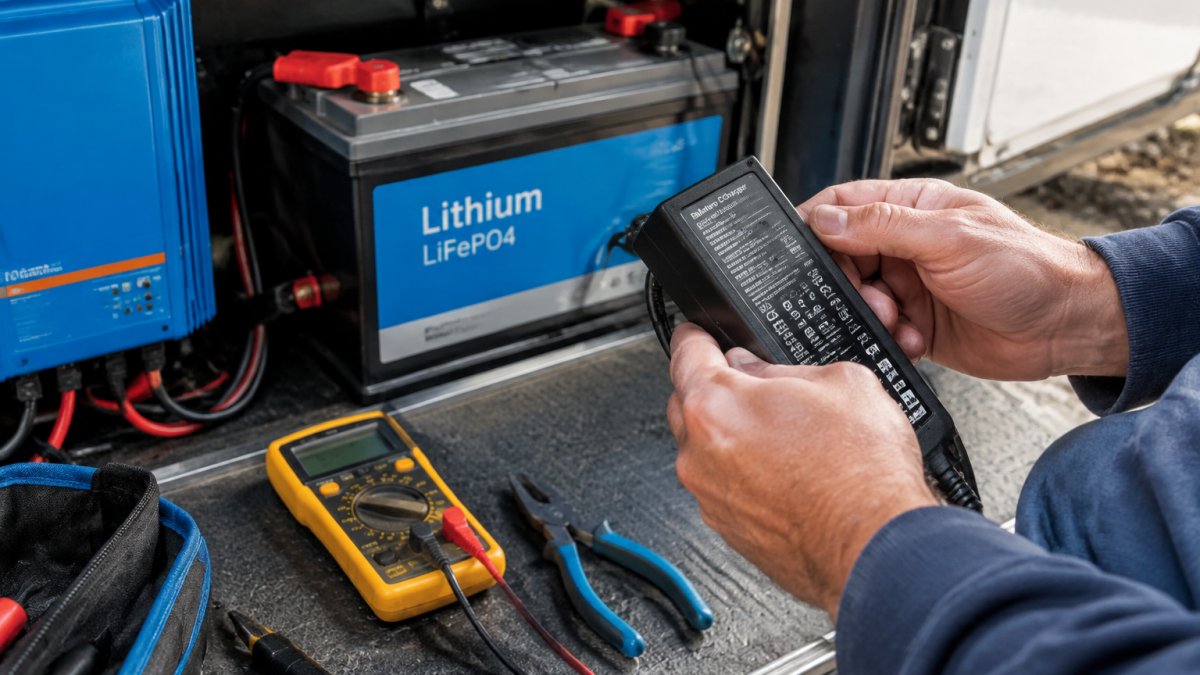
The case label usually lists input voltage, output voltage, and output current, but those are often nominal. A charger marked "12V" may output 13.6V in float and 14.8V in equalization. You need the absorption voltage, float voltage, and whether an equalization or desulfation stage exists. Check three places in this order:
- The charger case label or sticker, which lists nominal output and sometimes the charge profile
- The owner's manual or spec sheet, which lists absorption, float, and equalization voltages
- The charger's settings menu, if it has one, which shows the active profile and whether lithium mode is available
If the label only says "12V" and the manual is missing, you cannot confirm compatibility from paperwork. Test the charger's output with a multimeter before connecting a lithium battery: set it to DC volts, connect the charger to a known load or the battery, and watch voltage through a full charge cycle. A charger that climbs above your battery's absorption limit or holds float after full charge is not safe for lithium.
The Compatibility Decision Tree
Rather than a yes-or-no answer, work through these five questions in order. If you answer no to any question, the charger is not compatible without adjustment or replacement.
- What chemistry is the battery? LiFePO4, lithium-ion, and lithium-polymer have different voltage limits. LiFePO4 12V packs typically want 14.2 to 14.6V absorption, while lithium-ion 12V equivalents may want 12.6V nominal with a 12.6V charge limit. Confirm the chemistry on the battery label before comparing voltages.
- What is the battery's nominal voltage? A 12V lithium pack is not the same as a 12.8V nominal pack. Match the charger's output range to the battery's nominal voltage, not the label on the charger.
- Does the charger's absorption voltage fall within the battery maker's spec? Compare the charger's absorption voltage to the battery's maximum charge voltage. A charger that exceeds the limit will trigger the BMS or stress cells.
- Does the charger stop charging when the battery is full? Lithium batteries should not sit at a float voltage. A charger that holds 13.6V indefinitely is adding stress. Look for a charger with a clean cutoff or a lithium profile that ends absorption without float.
- Can equalization and desulfation be turned off? These modes are for lead-acid only. If the charger runs them automatically and cannot be disabled, it is not suitable for lithium.
Reading the Battery Spec Sheet
The battery maker's spec sheet lists the numbers you need: maximum charge voltage, recommended charge current, and sometimes a charge temperature range.
Current matters too. Too high a rating overwhelms a small bank; too low may never finish absorption.
Watch out: a charger labeled only "12V" tells you almost nothing. You need the absorption and float voltages, not the nominal rating.
Cold, Heat, and a Battery That Won't Take a Charge: Troubleshooting Real Scenarios
Temperature is the most overlooked charging variable. Lithium batteries resist charging in the cold and dislike high heat.
Most LiFePO4 batteries block charging below freezing to protect the cells. A BMS with low-temp cutoff simply refuses current until the battery warms up.
Heat is the other end of the scale. Charging a hot battery stresses cells and can trigger the BMS.
When a battery will not accept a charge, work through the causes in order:
- The BMS has tripped on low temperature or overvoltage
- The charger voltage is below the battery's threshold
- A cell is out of balance and the BMS is protecting the pack
- The charger itself has failed
Our lithium battery safety rules cover how to diagnose these without risking damage. If you regularly camp in the cold, our roundup of lithium batteries for cold weather covers tested options built for low temperatures.
Charging a lithium bank safely comes down to matching every charge source to the battery's spec.
Frequently Asked Questions
What happens if you use a regular charger on a lithium battery?
It depends on the charger. A standard sealed lead-acid (SLA) charger can charge a lithium battery in some cases, but only if its charging voltage suits the battery's chemistry. The real risk comes from lead-acid-only modes: equalization, desulfation, and float stages that hold a voltage a lithium battery should not sit at. Those modes can push a lithium battery past its voltage limit, and without a functioning battery management system (BMS) to cut the charge, you risk permanent damage.
Will any charger work on a lithium battery?
No. A LiFePO4 battery does not need a charger from a specific brand, but it does need charging equipment with an appropriate voltage. Before connecting anything, confirm the charger's output voltage matches your battery's spec, that it has a lithium or CC/CV charging profile, and that it will stop charging at the correct voltage limit. A charger that only offers lead-acid modes is the wrong tool for a lithium battery charger job.
Do lithium batteries need a special solar charger?
A solar charge controller needs a lithium charging profile, not necessarily a special brand. Look for a controller with an adjustable or preset lithium mode, a charge voltage that matches your battery's spec, and temperature compensation handled correctly.
How do I know if my RV charger is compatible with a lithium battery?
Check three things on the charger's label or manual: the output voltage (a 12V LiFePO4 pack typically uses a charge profile in the 14.2-14.6V range), the available charging modes (you want lithium or CC/CV, not equalization or desulfation), and the charge termination behavior. If the charger only lists lead-acid modes and cannot be reconfigured, treat it as incompatible and replace it with a lithium-capable unit before installing your battery bank.
Why does my lithium battery refuse to accept a charge?
A BMS will block charging when conditions fall outside its safe range. The most common causes are cold temperatures (many BMS units stop charge below freezing), a deeply discharged pack, or a charger voltage that never reaches the BMS threshold. Warm the battery above its minimum charging temperature, confirm the charger output with a multimeter, and check the BMS status through its app or monitor before assuming the battery is dead.