 how-to
Why RV Batteries Keep Dying: Diagnose & Fix
Table of Contents
- Common Causes Your RV Batteries Keep Dying
- RV Battery Draining Overnight: Test and Isolate the Problem
- Parasitic Battery Drain in an RV: Find and Eliminate Hidden Draws
- RV Battery Draining While Plugged Into Shore Power: Charging System Faults
- RV Battery Maintenance: Prevent Premature Failure
- Distinguish a Bad Battery From a Charging-System Problem
- Safety Precautions During Electrical Troubleshooting
- Conclusion
- Frequently Asked Questions
Last Updated: October 12, 2026
Common Causes Your RV Batteries Keep Dying
When your RV batteries keep dying, the culprit is rarely the battery itself, usually something in your electrical system is draining power faster than it should. Some components draw energy even when you're not using them or fail silently, draining your batteries overnight. Most causes are fixable without replacing your battery, but finding the source requires systematic testing.
Parasitic loads and phantom draws
A parasitic load is any device that draws power when you don't expect it, your refrigerator, water heater, slide-out motor, and entertainment system all pull current continuously.
Phantom draws are loads you didn't know existed, a USB socket left powered, a converter running when it shouldn't, a circuit that never fully shuts off.
Converter and charger faults
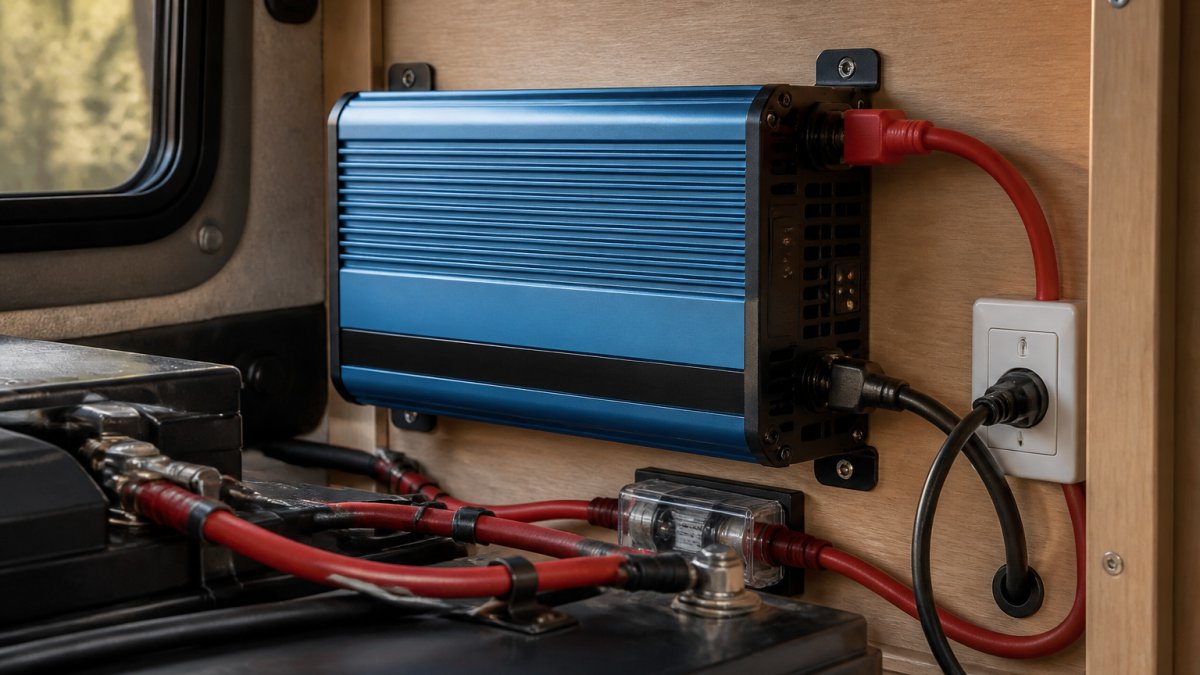
Your converter transforms shore power into 12-volt DC current. When it fails, it either stops charging entirely or charges at the wrong voltage. A faulty converter can actually drain your battery instead of charging it, when the internal diodes fail, it becomes a one-way drain, pulling current from your battery to ground.
Battery age and sulfation
Lead-acid batteries lose capacity after 3-5 years and often fail completely after 5-7 years. Sulfation, lead sulfate crystals building up on the plates when a battery sits partially discharged, reduces its ability to hold and accept a charge, so an older, sulfated battery dies faster than a new one in the same system.
RV Battery Draining Overnight: Test and Isolate the Problem
Your battery dies overnight even though nothing is running, the most common complaint. The fix starts with measurement.
Measure resting voltage and state of charge
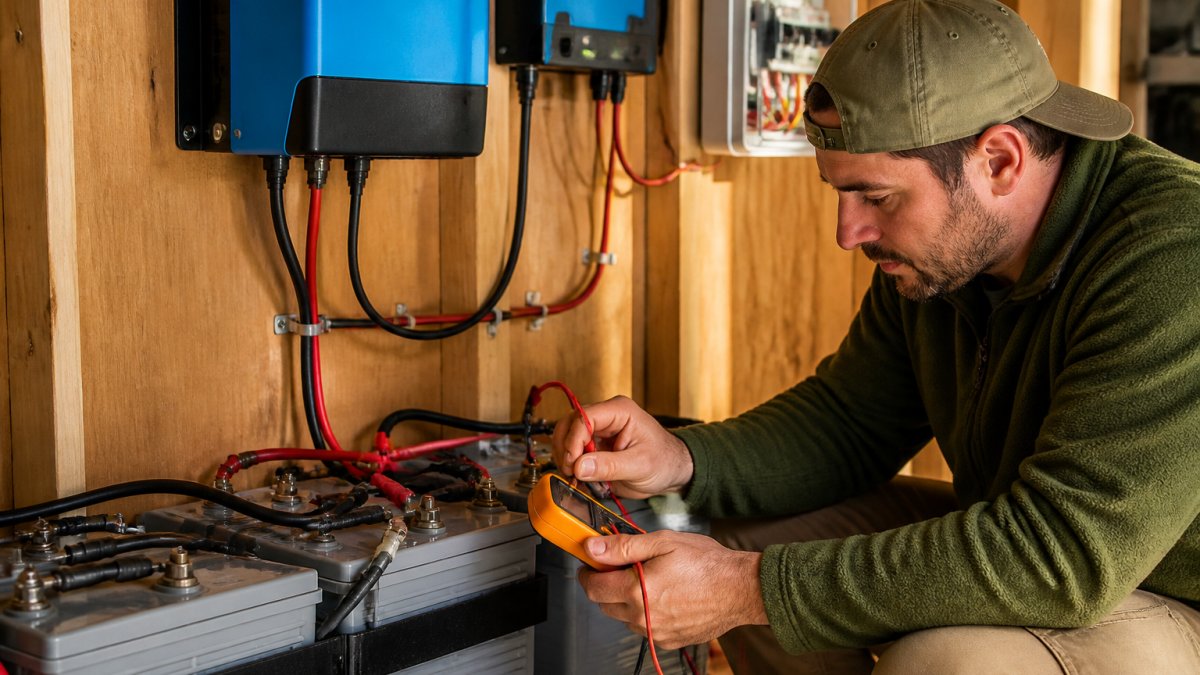
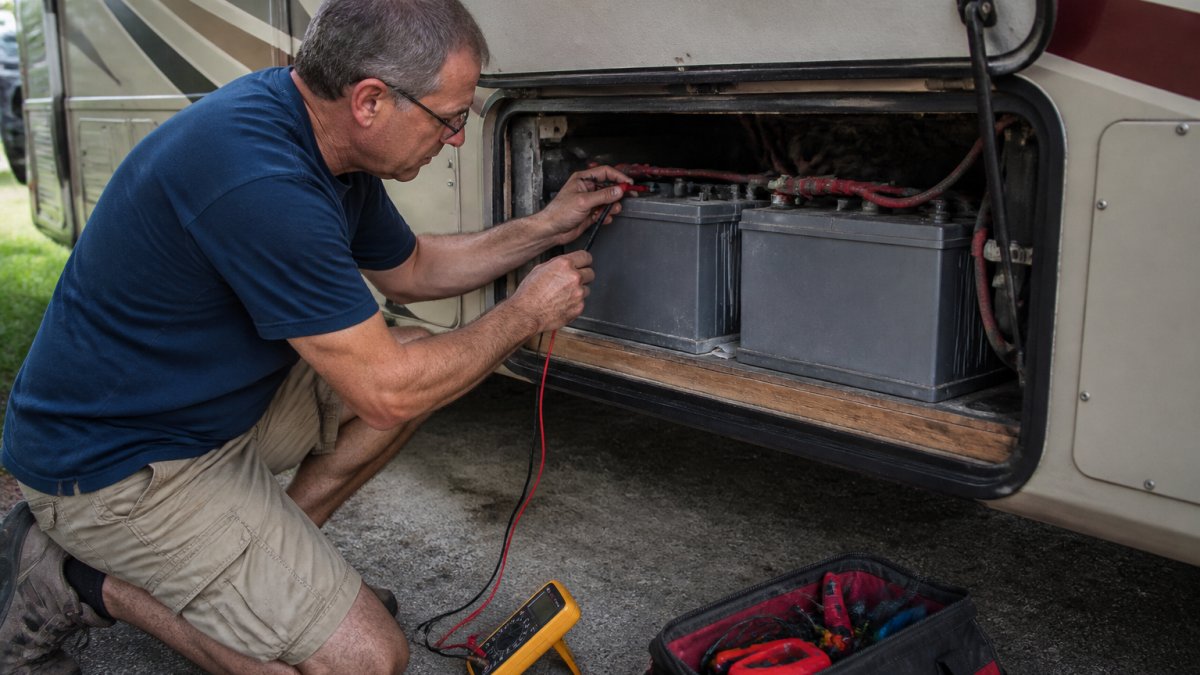
First, measure your battery's resting voltage with a multimeter set to DC volts, red probe on positive and black on negative. A fully charged 12-volt lead-acid battery reads 12.6 volts or higher at rest, 50% charge reads around 12.0 volts, and below 11.5 volts means deep discharge.
Perform a multimeter load test
A load test reveals weak batteries that might pass a voltage check. Here's how:
- Set your multimeter to DC amps
- Disconnect the negative battery cable
- Connect the multimeter in series between the negative cable and the negative terminal
- Reconnect your RV systems one at a time
- Observe the current draw for each system
- Record which systems draw the most current
A healthy battery shows stable voltage under load; a sudden drop when you turn on a system means it's weak. If it passes the load test but still dies overnight, something is draining it while you sleep.
Calculate expected runtime and power consumption
Battery capacity is measured in amp-hours: a 100-amp-hour battery can theoretically deliver 100 amps for one hour, or 1 amp for 100 hours. You can't use 100% of capacity: lead-acid should never go below 50%, and lithium is usually kept above 20% for longevity.
Parasitic Battery Drain in an RV: Find and Eliminate Hidden Draws
Once you know your battery is draining too fast, finding the cause requires patience and a multimeter.
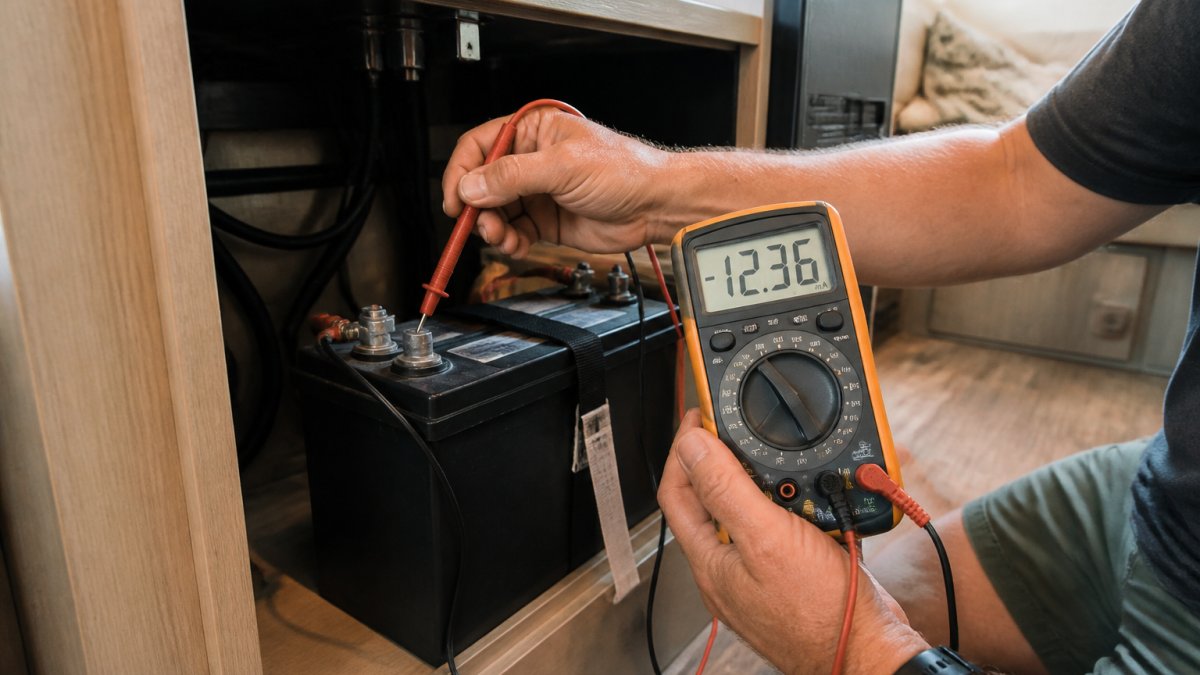
Test for phantom draw with a multimeter
Set your multimeter to DC amps, disconnect the negative battery cable, and connect the meter in series between cable and terminal to measure all current flowing from your battery.
Most RVs draw 50-200 milliamps in "sleep mode" with everything off; anything above 500 milliamps indicates a problem.
One amp or more is a serious phantom draw, 24 amps per day, which kills a 100-amp-hour battery in 4 days.
Write down the baseline draw as your starting point.
Isolate circuits to locate the source
Turn systems on and off one at a time and watch the meter, the current jumps when you hit the culprit.
Start with the obvious systems:
- Refrigerator
- Water heater
- Slide-out motor
Then move to less obvious ones:
- USB ports and chargers
- Interior lights
- Exterior lights
Note the current increase each time; a system drawing more than expected is your problem.
If the draw stays high with all systems off, check your breaker panel and wiring for a circuit that never shuts down.
Common parasitic culprits: USB sockets, accessory circuits, and loose connections
USB sockets are notorious phantom draws, many stay powered even when the RV is off, pulling 50-100 milliamps continuously. Accessory circuits for exterior cameras, backup sensors, or entertainment systems stay powered constantly if their relay fails. Loose connections create resistance, generating heat and wasting power, a corroded or loose terminal makes your charger work harder and pull more current.
RV Battery Draining While Plugged Into Shore Power: Charging System Faults
If your battery dies while plugged into shore power, you have a converter or charger problem.
Converter or charger malfunction
Your converter takes 120-volt AC shore power and converts it to 12-volt DC to charge your battery and power your systems.
A failed converter shows these symptoms:
- Battery voltage stays low despite being plugged in for hours
- Battery dies faster while plugged in than when unplugged
- Converter makes buzzing or humming sounds
If it fails, your battery won't charge and drains faster because your 12-volt systems keep drawing power with nothing replacing it.
Measure battery voltage while plugged in, wait 30 minutes, and measure again, if it hasn't risen at least 1 volt, your converter isn't charging properly.
Incomplete charging and voltage regulation
Sometimes your converter works but charges at the wrong voltage, a regulation problem.
A healthy converter charges lead-acid to 13.5-14.5 volts; lower means slow or incomplete charging, higher overcharges and damages the battery over time.
Lithium needs 13.8-14.2 volts; outside that range it can be permanently damaged.
Measure charging voltage while plugged in, outside the normal range means your converter needs adjustment or replacement.
Testing charging voltage and current flow
Here's how to test your charging system:
- Set your multimeter to DC volts
- Measure battery voltage with nothing plugged in (baseline)
- Plug into shore power
- Wait 5 minutes
- Measure battery voltage again
- The difference should be at least 1 volt
Less than 1 volt increase means your charger is weak or failing.
Next, measure charging current: set the multimeter to DC amps, disconnect the negative cable, connect in series, and plug into shore power.
According to the American RV Association's electrical standards, charging systems should maintain voltage regulation within 0.5 volts of the target.
RV Battery Maintenance: Prevent Premature Failure
Most battery failures are preventable. Good maintenance extends battery life by years.
Water levels and electrolyte care for lead-acid batteries
Lead-acid batteries contain electrolyte (sulfuric acid and water).
Check the water level monthly: remove the cell caps and confirm the electrolyte covers the plates by about half an inch.
Lithium batteries are sealed and need no water, but require proper charging voltage and current limits.
Terminal corrosion and connection integrity
Corroded terminals create resistance, generating heat and wasting power.
Check terminals monthly: white, blue, or green crusty buildup is corrosion, scrub it off with baking soda, water, and an old toothbrush.
After cleaning, apply a thin layer of dielectric grease to prevent new corrosion.
Also tighten any loose battery cables, which cause the same problems as corrosion.
Seasonal storage and long-term self-discharge
Stored batteries self-discharge: lead-acid at about 1-2% per month, lithium much slower at around 0.1% per month.
Before storing, fully charge your battery and disconnect the negative cable to stop parasitic loads from draining it.
For extended storage, a battery disconnect switch cuts all power to your RV systems and is the best way to prevent phantom draws.
Distinguish a Bad Battery From a Charging-System Problem
A dying battery and a failing charger look similar, but the fixes differ completely.
Voltage signature and stress test results
A bad battery shows these voltage patterns:
- Resting voltage below 12.4 volts (even after charging)
- Voltage drops suddenly when you turn on a load
- Voltage doesn't recover after the load is removed
A failing charger shows different patterns:
- Resting voltage is normal (12.6+ volts)
- Voltage stays high under load
- Voltage doesn't increase when you plug into shore power
The key difference: a bad battery can't hold voltage. A failing charger can't create voltage.
To test, measure resting voltage, charge fully, and measure again: still low means a bad battery; high after charging means a bad charger.
When to replace the battery versus repair the charger
Replace your battery if:
- It's older than 5-7 years
- Resting voltage stays below 12.0 volts even after charging
- It fails a load test (voltage drops more than 1 volt under load)
Repair or replace your charger if:
- Battery voltage doesn't increase when plugged into shore power
- Charging voltage is outside normal range
- The charger makes unusual noises or gets extremely hot
If unsure, borrow or rent a different charger, if it charges your battery successfully, your original charger is the problem.
Research from the National Association of RV Parks and Campgrounds technical resources shows that 70% of "dead battery" complaints are actually charger or converter problems, not battery failures.
Safety Precautions During Electrical Troubleshooting
Working with your RV's electrical system can be dangerous. Batteries store enough energy to cause serious injury.
Wear safety glasses near batteries; acid is corrosive and can damage your eyes.
If you're uncomfortable with electricity, hire a professional, a diagnosis costs less than replacing a battery that didn't need it.
Conclusion
Start with the multimeter tests we covered, resting voltage, load test, phantom draw, charging voltage. They take an hour and reveal the truth.
Once you know what's wrong, the fix is usually simple. A loose connection. A failed converter. A USB socket that won't turn off.
At Victron Guy, we help customers diagnose these issues every day. We stock high-quality Victron Energy batteries, chargers, and monitoring systems designed to work reliably in RVs, boats, and off-grid homes.
| Problem | Test | Solution |
|---|---|---|
| Battery won't charge while plugged in | Measure charging voltage | Replace or repair converter |
| Battery dies overnight | Multimeter phantom draw test | Find and isolate parasitic load |
| Battery fails load test | Measure voltage under load | Replace battery |
| Charging voltage too high or low | Multimeter DC volts test | Adjust or replace charger |
| Corroded terminals | Visual inspection | Clean and apply dielectric grease |
Frequently Asked Questions
Why is my RV battery not holding a charge?
RV batteries fail to hold a charge due to several causes: a weak or sulfated battery nearing end-of-life, incomplete charging from a faulty converter or charger, parasitic loads draining power overnight, or loose corroded terminals reducing electrical connection. Test the resting voltage with a multimeter, a healthy battery reads 12.6 volts or higher. If voltage drops below 12 volts at rest, perform a load test. If the battery fails the test, replacement is likely needed. If voltage is adequate but drains rapidly under load, suspect a parasitic draw or charging-system fault instead.
How do I test for a parasitic drain on an RV battery?
Set a multimeter to DC amps and connect it in series between the negative battery terminal and the negative cable (disconnect the cable first). A healthy RV draws less than 50 milliamps at rest. Anything above 100 milliamps indicates a phantom draw. Isolate the problem by disconnecting circuits one at a time, fuse by fuse or breaker by breaker, until the current drops. Common culprits include USB sockets, interior lights, water heaters, and alarm systems left running. Once you find the circuit, inspect for loose wiring, a stuck relay, or a failed component drawing constant power.
Can a bad RV battery charger cause overnight battery drain?
Yes. A faulty converter or charger may fail to raise the battery to full charge, leaving it partially depleted before nightfall. It can also develop a reverse-current leak, allowing power to flow backward from the battery into the charger circuit when shore power is off. Test the charging voltage with the RV plugged in, it should reach 13.5 to 14.5 volts. If it stays below 13 volts or fluctuates, the charger is likely faulty. Disconnect the charger and monitor overnight drain; if drain stops, the charger is the problem and needs replacement or repair.
What is the difference between a dead battery and a charging system failure?
A dead battery has low resting voltage (below 12 volts) and fails a multimeter load test, it cannot hold voltage under electrical load. A charging-system failure keeps the battery at healthy resting voltage but the voltage drops quickly once you draw power, or the battery drains overnight despite being fully charged before bed. Test both: measure resting voltage, then apply a 100-amp load for 15 seconds and observe how quickly voltage recovers. If the battery recovers quickly, the charger or converter is the problem. If voltage stays low or recovers slowly, the battery itself is worn and needs replacement.