 how-to
RV Inverter Surge Capacity: A Step-by-Step Guide
Table of Contents
- Understanding Inverter Surge Capacity for RV Appliances
- Inverter Continuous vs. Surge Power Explained
- Calculating RV Appliance Startup Watts
- Inverter Size for RV Air Conditioner Units
- Inverter Size for RV Refrigerator and Freezer
- Common RV Appliance Wattage Examples and Startup Demands
- Choosing the Right Inverter Size and Wave Type
- Sizing Your System: Practical Worked Examples
- Frequently Asked Questions
Last Updated: October 13, 2026
Understanding Inverter Surge Capacity for RV Appliances
When your RV's air conditioner or refrigerator compressor starts, it demands far more power in that first fraction of a second than while running.
Inverter surge capacity is your system's ability to handle these temporary power spikes without shutting down.
The fix requires understanding how surge works, what your appliances demand, and how to match your battery and wiring to those demands.
Continuous Watts vs. Surge Watts
Continuous watts is the steady power an appliance draws while running, a microwave might use 1,000, a refrigerator compressor 600 once spinning.
Surge watts (peak power or inrush current) is the startup spike.
The gap between these numbers determines whether your inverter can start the appliance at all.
Most RV appliances surge for 0.5 to 3 seconds.
Why Surge Duration Matters
Not all surge ratings are equal. One inverter rated for 5,000 watts of surge might hold it for 10 milliseconds; another might sustain it for 3 seconds. The second is far more useful for RV appliances, since most startup demands outlast 10 milliseconds. When reading specs, look for surge duration, a 3-second rating at 5,000 watts beats a 100-millisecond rating at the same wattage.
Inverter Continuous vs. Surge Power Explained
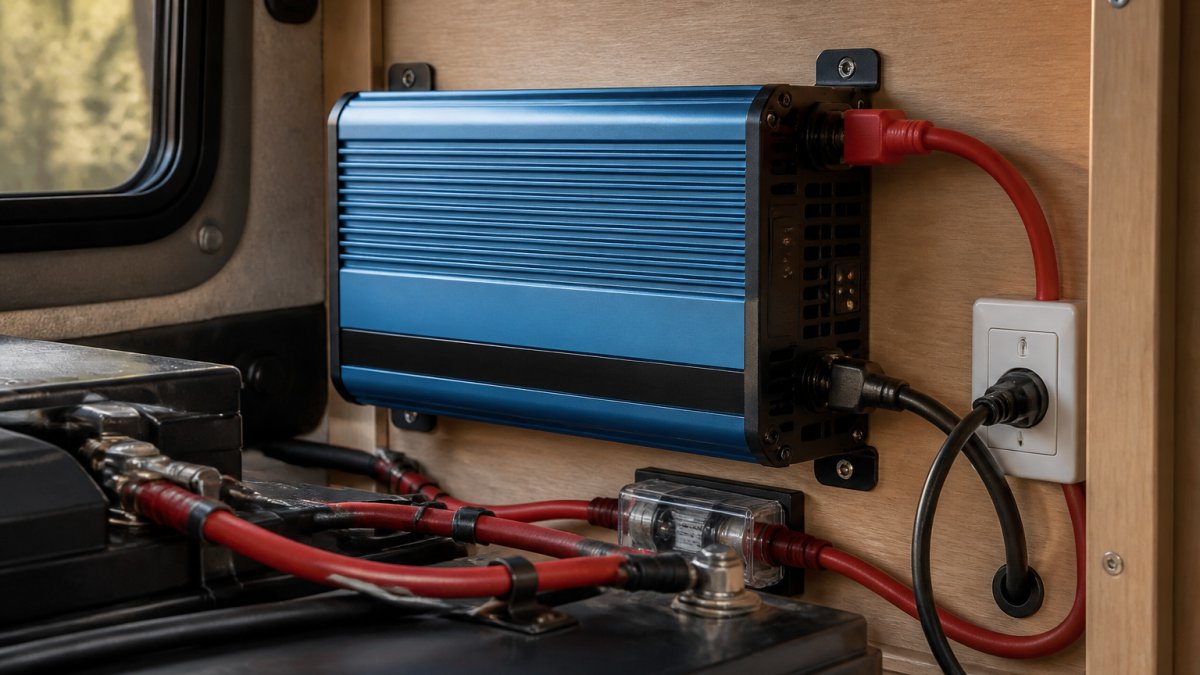
Your inverter's nameplate shows two ratings: continuous power, delivered all day without overheating, and surge power, its brief emergency capacity. Exceed continuous power for more than a few seconds and it overheats and shuts down; exceed surge power at all and it trips immediately.
How Inrush Current Works in Motors and Compressors
A motor at standstill has zero back-EMF (back electromotive force), the voltage a spinning motor generates to oppose the applied voltage. With no back-EMF, it looks like a short circuit, and its resistance is far lower than while spinning.
Refrigerator compressors, AC compressors, and water pump motors all draw 2 to 4 times their running current during the first second or two of startup.
Reading Inverter Specifications
A spec sheet reading "3,000W continuous / 6,000W surge" means the inverter delivers 3,000 watts indefinitely but handles 6,000 watts for a short burst. Surge-to-continuous ratios vary: pure sine wave inverters often hit 2:1 or 3:1, while modified sine wave units may reach 3:1 or 4:1.
Check the fine print for surge duration. "6,000W for 3 seconds" is far more useful than "6,000W for 100 milliseconds."
Calculating RV Appliance Startup Watts
Sizing your inverter starts with listing every appliance you might run and finding its startup demand.
Step 1: Identify Your Appliances and Their Ratings
Check the manual or nameplate on each appliance for running watts and startup watts (or inrush current).
For common RV appliances:
- Air conditioner: startup is typically 2 to 3 times running watts
- Refrigerator: startup is typically 2 to 4 times running watts
- Microwave: startup is usually similar to running watts
- Water pump: startup is typically 2 to 3 times running watts
- Television and laptop charger: no significant startup surge
If startup watts aren't listed, multiply running watts by 2.5 as a conservative estimate for motors and compressors.
Step 2: Account for Simultaneous Motor Loads
The critical mistake happens here: many RV owners add up every appliance's startup demand and assume the inverter must handle the total. You rarely start everything at once, but you might start two or three. Size for the worst case: the two largest startup loads running simultaneously.
Step 3: Add Safety Margin and Voltage Drop
Once you've calculated peak startup demand, add 20% as a safety margin for voltage drop in your wiring and battery cables.
DC wiring has resistance, and current flowing through it causes voltage loss.
If peak startup demand is 4,700 watts, add 20%: 4,700 × 1.2 = 5,640 watts. Round up to 6,000 watts for your inverter's required surge capacity.
Inverter Size for RV Air Conditioner Units
Air conditioners are the largest power load in most RVs, so AC startup sizing limits your entire system design.
15,000 BTU and Larger AC Startup Demands
A typical 15,000 BTU RV air conditioner draws about 1,500 watts running, but demands 3,500 to 4,500 watts for the first 2 to 3 seconds while the compressor accelerates. Larger units (20,000 BTU or higher) can demand 5,000 to 6,500 watts at startup.
Startup demand depends on compressor type, refrigerant charge, and ambient temperature, hot days produce higher surges.
Battery and Wiring Requirements for AC Operation
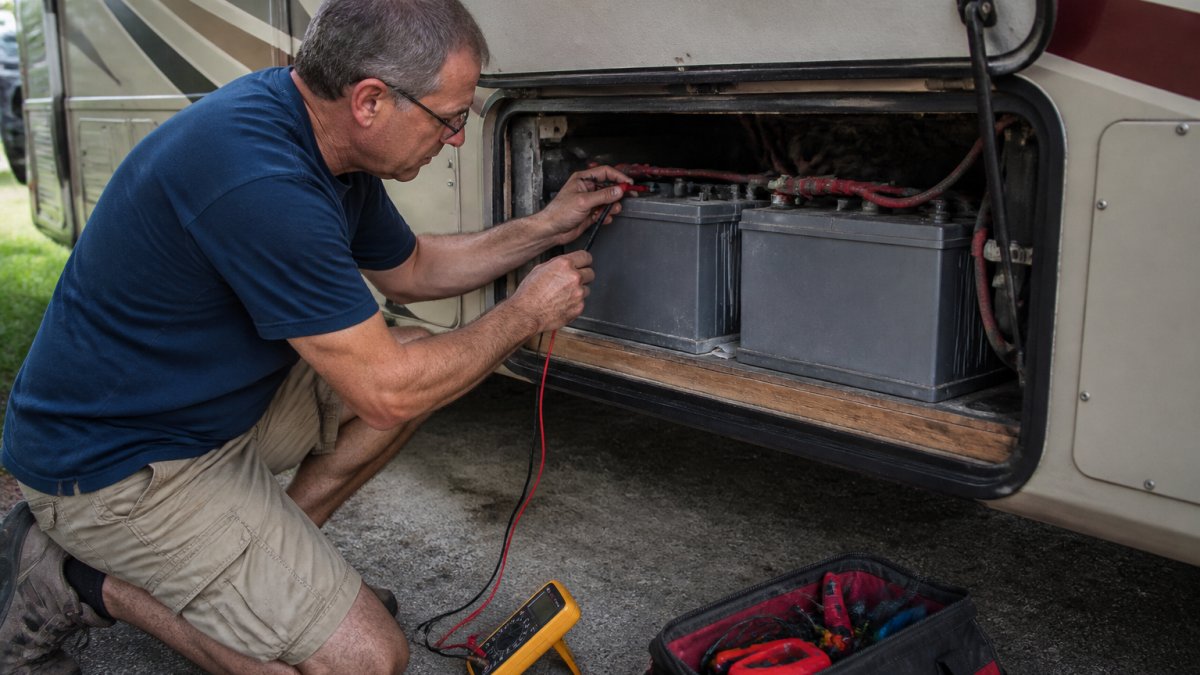
An inverter's surge capacity is only half the equation, your battery bank and DC wiring must support that surge too.
When the inverter draws 6,000 watts of surge, the battery must supply that current without collapsing in voltage. A small bank will sag below 10 volts and force a shutdown.
Inverter Size for RV Refrigerator and Freezer
RV refrigerators are the second-largest power load after air conditioners, but they cycle on and off all day, so your inverter must handle startup surges repeatedly.
110-Volt Refrigerator Surge Requirements
A typical 110-volt RV refrigerator draws 600 to 800 watts running and demands 1,200 to 1,600 watts for 1 to 2 seconds at startup.
The refrigerator's surge is predictable and repeatable, the compressor starts and stops based on internal temperature, so you'll see multiple startup surges per hour, especially on hot days.
Managing Refrigerator Cycling and Battery Drain
The challenge isn't a single startup surge but repeated cycling: each compressor start sags battery voltage, and a too-small bank triggers the inverter's low-voltage shutdown.
You can also keep the refrigerator in propane mode when not on shore power. Propane operation uses minimal 12-volt DC power for the control circuit, with the heating element powered by propane, not electricity.
Common RV Appliance Wattage Examples and Startup Demands
Here's a practical reference for the appliances you'll actually use in your RV:
| Appliance | Running Watts | Startup Watts | Duration |
|---|---|---|---|
| 15,000 BTU Air Conditioner | 1,500 | 3,500-4,500 | 2-3 seconds |
| 110V Refrigerator | 600-800 | 1,200-1,600 | 1-2 seconds |
| Microwave Oven | 1,000 | 1,000-1,200 | 0.5 seconds |
| Water Pump (12V DC) | 8-15 | 20-40 | 0.1 seconds |
| Television | 100-200 | 100-200 | Minimal |
| Laptop Charger | 50-100 | 50-100 | Minimal |
| Coffee Maker | 800-1,200 | 800-1,200 | 0.5 seconds |
| Space Heater | 750-1,500 | 750-1,500 | Minimal |
Microwave, Television, Water Pump, and Other Loads
Microwaves draw high power but minimal startup surge, the magnetron energizes quickly, so demand is nearly the same at startup as during operation.
Water pumps are small, low-power motors: a 12-volt DC pump might draw 20 amps (240 watts) at startup and 10 amps (120 watts) running. The surge is brief and manageable.
Multiple Motors Starting at the Same Time
The worst case is multiple motors starting simultaneously. If your AC compressor starts the same moment as your refrigerator compressor, say the thermostat calls for cooling while the fridge cycles on, your inverter must handle both surges at once.
Add the startup watts of your two largest motor loads: if the AC needs 4,000 watts and the refrigerator 1,400, the inverter must handle 5,400 watts.
Choosing the Right Inverter Size and Wave Type
Once you've calculated peak startup demand, choose between pure sine wave and modified sine wave inverters, the choice affects both surge capacity and appliance compatibility.
Pure Sine Wave vs. Modified Sine Wave
Pure sine wave inverters match utility grid power, with voltage rising and falling smoothly in a perfect sine curve.
Modified sine wave inverters approximate a sine wave with a stepped waveform.
For RV use, pure sine wave is the safer choice: the cost difference is small and the reliability gain significant.
Battery Bank Capacity and Voltage Drop Considerations
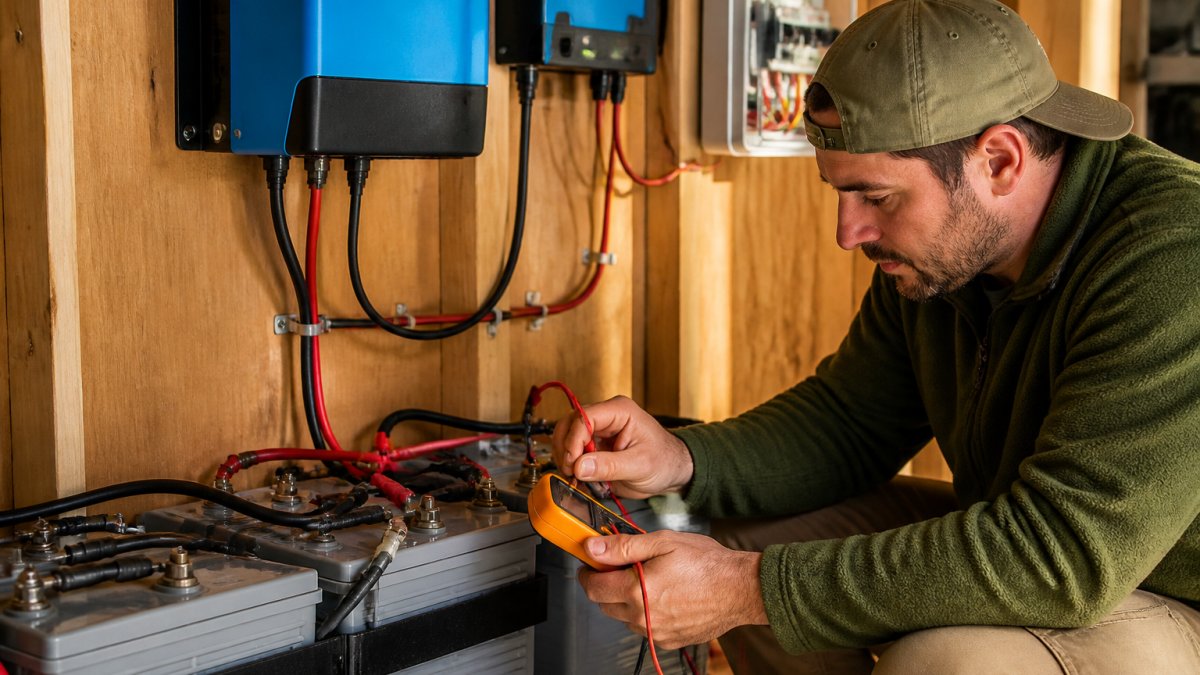
Your inverter's surge capacity means nothing if your battery can't supply the current. A 6,000-watt surge at 12 volts requires 500 amps, and your bank must deliver that without collapsing in voltage.
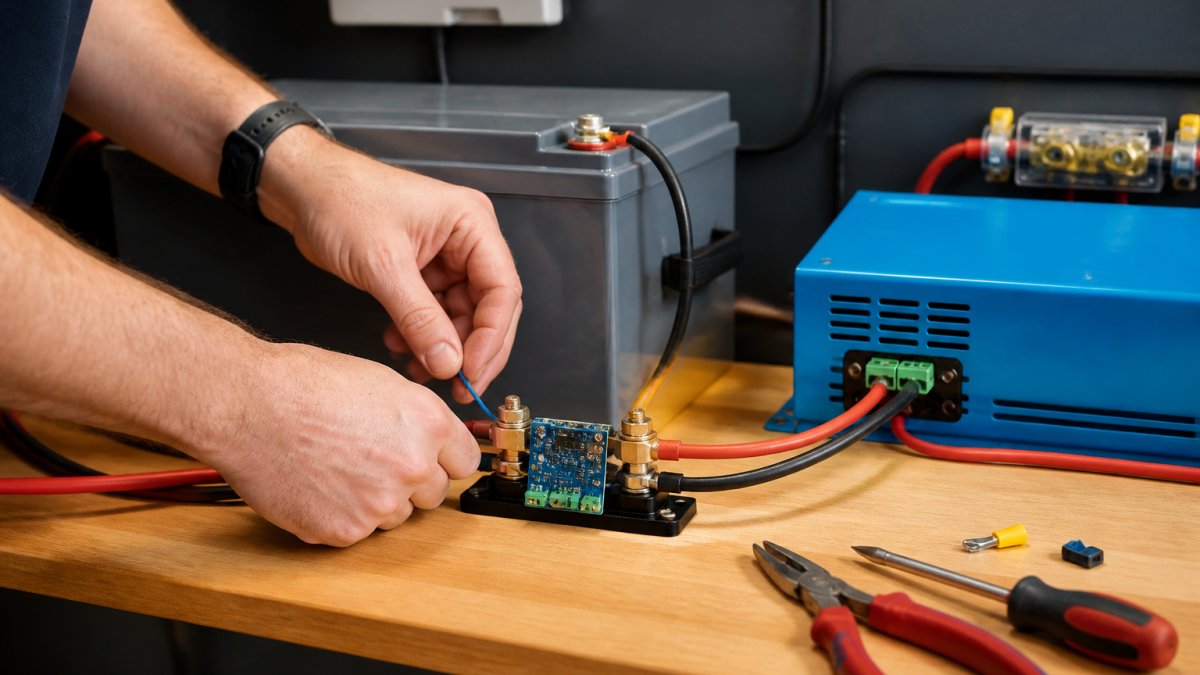
Wiring is equally critical. Undersized or overly long battery-to-inverter cables sag at the input during surge, and the inverter shuts down below its minimum threshold (usually 10 volts for 12-volt systems).
Soft-Start Devices and Other Surge Reduction Methods
Soft-start devices reduce inrush current by gradually ramping voltage to the motor over a fraction of a second, cutting peak current and letting smaller inverters start large loads.
For most RVers, oversizing the inverter is simpler and can handle any appliance without added complexity.
Sizing Your System: Practical Worked Examples
Real-world examples show how to apply these principles to your setup.
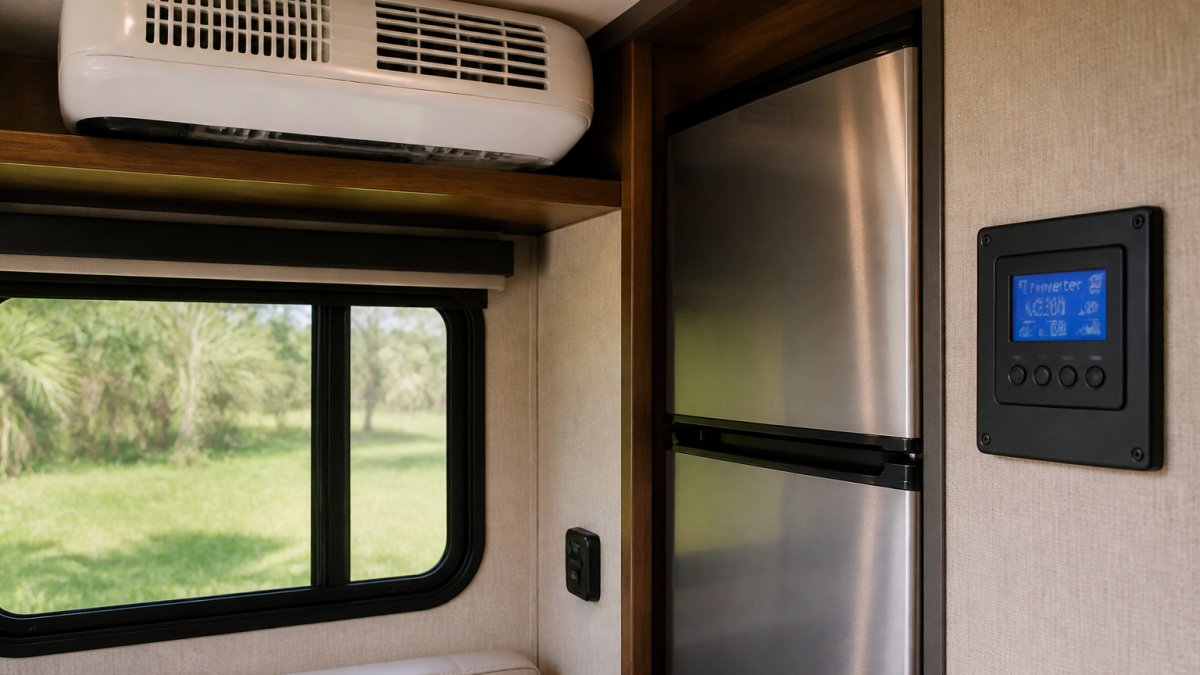
Example 1: Dry Camping with AC and Refrigerator
You're dry camping with a 15,000 BTU air conditioner and a 110-volt refrigerator.
Air conditioner startup: 4,000 watts Refrigerator startup: 1,400 watts Combined worst-case startup: 5,400 watts Add 20% safety margin: 5,400 × 1.2 = 6,480 watts
You need a 6,500-watt pure sine wave inverter minimum.
The AC draws about 1,500 watts continuous (125 amps at 12 volts), so you can't run it indefinitely, most RVers get 30 to 60 minutes before voltage sags too low.
Example 2: Off-Grid Mobile Office Setup
You're running a mobile office with a laptop, monitor, printer, and occasional microwave, no air conditioner or refrigerator.
Worst-case startup is the microwave at 1,200 watts.
A 200 amp-hour lithium bank is sufficient, your office draws about 350 watts average, roughly 30 hours before recharging from solar or a generator.
Sizing your inverter for surge capacity is the foundation of reliable RV power, without it, you'll face repeated shutdowns. Our team can review your appliance list, calculate your peak startup demand, and recommend a complete power system with matching battery bank and wiring.
Frequently Asked Questions
What's the difference between continuous watts and surge watts on an inverter?
Continuous watts is the steady power an inverter can supply indefinitely. Surge watts is the peak power it handles for a short time, usually 3 to 10 seconds, when motors or compressors start. For example, a refrigerator might draw 600 continuous watts but require 1,800 surge watts at startup. You must size your inverter to handle the surge demand, or it will shut down or damage your appliances.
How do I calculate the startup watts for RV appliances?
Find the running watts on each appliance's nameplate, then multiply by 2 to 4 for startup surge (motors and compressors draw more current when starting). For air conditioners, multiply by 3 to 4. Add the running watts of all appliances that might start at the same time, then add 20% safety margin. This total is your minimum inverter surge capacity. Account for voltage drop by adding another 10% if your DC wiring is longer than 20 feet.
Can an RV inverter actually start an air conditioner?
Yes, but only if your inverter and battery system are sized correctly. A 15,000 BTU air conditioner typically requires 3,500 to 4,500 surge watts and 1,200 to 1,500 continuous watts. You'll need a 5,000-watt pure sine wave inverter minimum, a large battery bank (400+ amp-hours of lithium or 600+ amp-hours of lead-acid), and heavy-gauge DC wiring to prevent voltage drop. Many RVers pair AC operation with a generator or solar array to recharge the battery quickly.
How long will an inverter run a refrigerator?
A 110-volt RV refrigerator draws roughly 600 running watts but cycles on and off. In practice, it runs 4 to 8 hours per 100 amp-hours of battery capacity, depending on ambient temperature, how often you open the door, and battery chemistry. A 400 amp-hour lithium battery might run a refrigerator 16 to 32 hours before dropping to 20% state of charge. Lead-acid batteries deplete faster and shouldn't go below 50% depth of discharge, cutting effective runtime in half.