 Ultimate guide
Choosing Charge Controllers for Lithium Batteries
Last Updated: October 23, 2026
Quick Summary
Choosing charge controllers for lithium batteries requires matching the controller type to your array voltage, ensuring lithium-specific charging profiles, and verifying BMS communication compatibility. MPPT controllers typically capture 20-30% more energy than PWM but cost more, while PWM works only when array voltage matches battery voltage.
- MPPT controllers capture 20-30% more energy than PWM from the same array in real-world conditions
- LiFePO4 batteries charge to 3.65 volts per cell, different from other lithium-ion chemistries that charge to 4.2 volts per cell
- Add a 25% safety margin to your array's short-circuit current when sizing controller input rating
- Cold weather increases panel Voc 15-20% above rated values, requiring a 10-15% safety margin above worst-case Voc
- Controllers must support CAN bus or other protocols for BMS communication to prevent overcharge damage
Table of Contents
- Why Charge Controller Selection Matters for Lithium Batteries
- MPPT vs. PWM Charge Controller: Which Type Works Best
- Solar Charge Controller Lithium Compatibility: What You Must Know
- Charge Controller Sizing for Solar Panels and Battery Capacity
- LiFePO4 Charge Controller Settings and Configuration
- Common Mistakes and Troubleshooting
- Frequently Asked Questions
Why Charge Controller Selection Matters for Lithium Batteries
Choosing charge controllers for lithium batteries is one of the most critical decisions you'll make when building an off-grid power system.
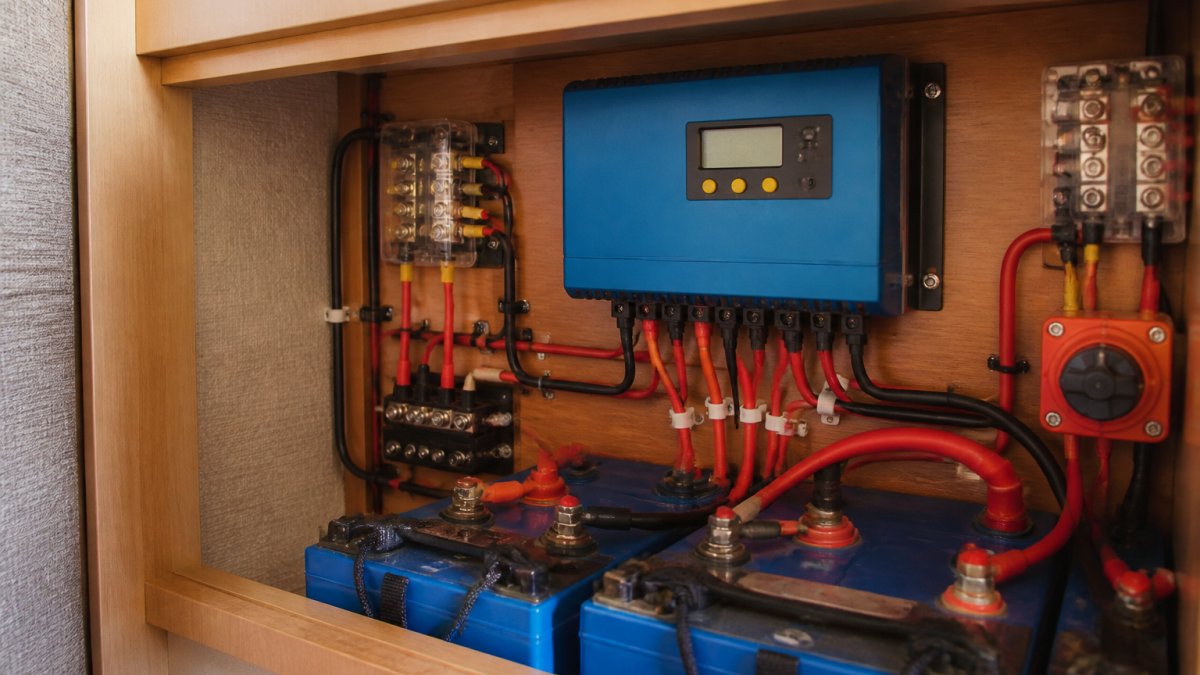
The stakes are higher with lithium than with lead-acid. Lithium chemistry demands precise voltage regulation and specific charging profiles that traditional controllers weren't designed to handle.
Below, we'll walk you through the technical requirements, the trade-offs between controller types, and the specific settings that protect your lithium investment.
MPPT vs. PWM Charge Controller: Which Type Works Best
The choice between maximum power point tracking (MPPT) and pulse-width modulation (PWM) controllers determines how much solar energy your system captures and how efficiently it charges your battery. These represent fundamentally different charging architectures with real performance implications.
How PWM Controllers Work
PWM controllers use a simple on-off switching mechanism to regulate charge current. When the battery reaches a set voltage threshold, the controller rapidly pulses the connection on and off, reducing the average current flowing into the battery.
This simplicity is both PWM's strength and limitation. The controller dissipates excess power as heat rather than converting it, so if your array voltage is higher than your battery voltage, PWM wastes that excess entirely.
How MPPT Controllers Work
MPPT controllers use DC-to-DC conversion to extract maximum power from your solar array regardless of voltage mismatch. An MPPT controller accepts a higher-voltage array and steps the voltage down to match your battery while maximizing current.
For lithium systems, MPPT controllers offer another critical advantage: flexible array configurations. You can wire panels in series to achieve higher voltage, then let the MPPT controller handle the conversion.
PWM vs. MPPT: Efficiency and Cost Trade-offs
PWM controllers cost significantly less upfront, often 40-60% cheaper than comparable MPPT units. For small systems with modest power requirements and array voltages that already match your battery voltage, PWM can be cost-effective.
MPPT controllers justify their higher cost through energy harvest. In real-world conditions, an MPPT controller typically captures 20-30% more energy than PWM from the same array. For lithium systems where you're already investing in premium batteries, the incremental cost of MPPT becomes negligible compared to the energy gains.
The decision hinges on three factors: array voltage relative to battery voltage, available installation space, and how much energy you need to harvest. If your array voltage already matches your system voltage and you have minimal expansion plans, PWM works. Otherwise, MPPT is the better choice for lithium systems.
Solar Charge Controller Lithium Compatibility: What You Must Know
Not every charge controller labeled "compatible" with lithium will actually protect your battery properly. Lithium compatibility requires specific voltage profiles, communication protocols, and safety cutoffs that generic controllers lack.
LiFePO4 vs. Other Lithium-Ion Chemistry
LiFePO4 (lithium iron phosphate) batteries dominate off-grid systems because they're safer, more stable, and have longer cycle life than other lithium-ion variants. LiFePO4 cells tolerate overcharge better and won't thermal runaway like NCA or NMC chemistries.
However, LiFePO4 requires different charging parameters than other lithium-ion types. A LiFePO4 battery charges to 3.65 volts per cell, while NCA batteries charge to 4.2 volts per cell.
Charging Profiles and Voltage Limits
Lithium batteries require three distinct charging stages: bulk, absorption, and float. Bulk delivers maximum current until the battery reaches a target voltage. Absorption holds that voltage while current tapers. Float maintains a lower voltage indefinitely to compensate for self-discharge.
For a 48-volt LiFePO4 system, bulk charging typically targets 55.2 volts (3.45V per cell × 16 cells), absorption might be 54.4 volts, and float sits around 51.2 volts. These are chemistry-specific thresholds that maximize cycle life. A controller that doesn't allow independent configuration of all three stages forces a compromise that shortens battery life or risks overcharge.
The best controllers for lithium systems let you program each stage independently, accommodating different battery brands that sometimes specify slightly different voltage targets.
Controller-to-BMS Communication
Your lithium battery's battery management system (BMS) monitors cell voltage, temperature, and internal resistance, cutting charge or discharge current when conditions exceed safe limits. A charge controller that ignores BMS signals can overpower the BMS's protection, causing shutdowns or damage.
Modern lithium-compatible controllers support CAN bus or other protocols that let the BMS signal the controller to reduce charging current.
Charge Controller Sizing for Solar Panels and Battery Capacity
Undersizing a charge controller leaves your array unable to charge your battery at full capacity; oversizing wastes money and adds complexity. Proper sizing matches controller current rating to your array's short-circuit current with a safety margin.
Calculating Current Capacity Requirements
Start with your array's short-circuit current (Isc), listed on each panel's spec sheet.
If you're wiring multiple strings in parallel, add their Isc values.
Don't confuse input current rating with output current rating. A 60-amp MPPT controller might accept 60 amps from the array but only deliver 40 amps to the battery due to voltage conversion losses. Check both ratings in the specs.
Matching Array Voltage and System Voltage
Your array's open-circuit voltage (Voc) must not exceed the controller's maximum input voltage.
For MPPT controllers, higher array voltage is fine as long as it stays within the controller's input limit. For PWM controllers, array voltage must match battery voltage, so a 48-volt PWM system requires panels wired to deliver 48 volts.
System voltage selection determines your entire electrical architecture.
Cold-Weather Voc and Safety Margins
Voc climbs in cold weather, sometimes 15-20% higher than rated values. A panel rated at 38 volts Voc in standard test conditions might reach 46 volts in subfreezing weather.
This is where many DIY systems fail. A controller rated for 150 volts maximum input exposed to 160+ volts in winter can fail catastrophically, damaging the entire system. Always add a 10-15% safety margin above your worst-case Voc.
LiFePO4 Charge Controller Settings and Configuration
Once you've selected a compatible controller, configuration determines whether your battery thrives or degrades prematurely. These settings are where theory meets practice.
Bulk, Absorption, and Float Stages
Bulk charging is your workhorse: maximum current flows until voltage reaches the absorption setpoint. For a 48-volt LiFePO4 system, bulk might deliver 80 amps, charging quickly from empty to 80% capacity.
Float maintains a lower voltage indefinitely, compensating for self-discharge without stressing the battery. Many controllers let you set float 2-3 volts below absorption.
Absorption time matters: too short and the battery doesn't fully charge, too long and you stress the cells unnecessarily.
Temperature Compensation and Low-Temperature Cutoffs
Battery chemistry changes with temperature. Cold batteries accept charge more slowly and need lower voltage setpoints to avoid damage. Most lithium batteries specify a minimum charging temperature, often 32°F (0°C).
A quality controller includes temperature compensation that adjusts voltage setpoints based on battery temperature, reading a sensor mounted on the battery and reducing charging voltage in cold conditions.
Low-temperature cutoff (LTC) is your safety net: when battery temperature drops below the minimum charging threshold, the controller stops charging until the battery warms, preventing the lithium plating damage that occurs when cold batteries are forced to accept charge.
Common Mistakes and Troubleshooting
The most frequent problem we see is incompatible voltage configuration. A customer buys a 48-volt lithium battery, pairs it with a 12-volt solar array, then wonders why the system barely charges.
Another common error is ignoring BMS communication requirements.
Undersized controllers cause chronic undercharging.
Inadequate cold-weather Voc margins create dangerous overvoltage conditions. A controller rated for 150 volts maximum exposed to 165 volts in winter fails silently or catastrophically.
Temperature sensor placement matters more than most installers realize.
Protecting a lithium battery system starts with choosing the right charge controller and configuring it properly.
At Victron Guy, we help customers navigate these decisions with expert guidance tailored to their specific setup. When you're investing in premium lithium batteries, the controller choice shouldn't be an afterthought, it's foundational to system longevity. Victron Energy's charge controller documentation outlines the specific compatibility requirements for their controller lineup, which we carry as an authorized dealer.
Frequently Asked Questions
Do you need a different charge controller for lithium batteries?
Yes. Lithium batteries require charge controllers with specific charging profiles that differ from lead-acid systems. Standard lead-acid controllers may overcharge lithium batteries or fail to communicate with battery management systems (BMS), risking damage or premature failure. A lithium-compatible charge controller uses proper bulk, absorption, and float voltage stages tailored to your battery chemistry, whether LiFePO4 or other lithium-ion types. Always verify compatibility before purchasing.
What are the recommended LiFePO4 charge controller settings?
LiFePO4 systems typically require a bulk voltage around 3.5-3.6V per cell (14.0-14.4V for 48-volt systems), absorption voltage of 3.55-3.65V per cell, and float voltage of 3.3-3.4V per cell. Low-temperature cutoffs should activate around 32°F to prevent charging in freezing conditions. Temperature compensation is critical: most controllers reduce charging voltage by 0.3-0.5% per degree Celsius below 25°C. Always consult your battery and controller manufacturer for exact settings, as they vary by chemistry and BMS design.
How do you size a charge controller for a lithium battery and solar array?
Size the controller by the highest input current your solar array can produce. Calculate this using: short-circuit current (Isc) of your panels × number of panels in parallel, then apply a 1.25 safety factor per electrical code. Next, verify the controller's maximum input voltage does not exceed its rating at the array's open-circuit voltage (Voc), accounting for cold-weather increases. Match the controller's output current rating to your battery's maximum charge current. Finally, ensure the controller matches your system voltage (12V, 24V, or 48V). Undersizing limits energy harvest; oversizing wastes money without benefit.
Can a solar charge controller overcharge a lithium battery?
Yes, if the controller is not lithium-compatible or improperly configured. Standard lead-acid controllers may apply excessive voltage or fail to recognize the battery's BMS cutoff signals, causing overcharging that damages cells or triggers BMS shutdown. A lithium-compatible controller with proper charging profiles and BMS communication prevents this. Additionally, a controller with a low-temperature cutoff stops charging in freezing conditions, protecting the battery from damage. Always verify your controller supports your specific lithium chemistry and communicates with your BMS.
What is the difference between MPPT and PWM charge controllers for lithium systems?
MPPT (maximum power point tracking) controllers adjust their input voltage to extract the most power from your solar array, typically delivering 20-40% more energy than PWM controllers. PWM (pulse-width modulation) controllers simply switch the solar array on and off, matching the battery voltage directly. Both can work with lithium batteries if properly configured, but MPPT is more efficient, especially in cold weather or with high-voltage arrays. MPPT costs more upfront but harvests more energy over the system's lifetime, making it ideal for off-grid systems where every watt counts.
Can you use an existing lead-acid charge controller with a lithium battery?
Not reliably. Lead-acid controllers use charging profiles designed for different chemistry: higher float voltages and longer absorption stages that can overcharge lithium batteries. They typically lack BMS communication, so they cannot respond to the battery's cutoff signals. Some older controllers may also lack low-temperature cutoffs, risking damage in cold weather. For safety and longevity, use a controller specifically rated for lithium batteries. Retrofitting an old controller to lithium settings is possible but requires technical expertise and may void warranties.
What happens if your solar array voltage is too high for the charge controller?
If the array's open-circuit voltage (Voc) exceeds the controller's maximum input voltage rating, the controller will shut down to protect itself, stopping all charging. This is a safety feature but means zero energy harvest. Cold weather increases Voc by roughly 0.4% per degree Celsius below 25°C, so a 48-volt array rated at 600V Voc at 25°C could reach 700V+ in freezing conditions. Always calculate worst-case Voc for your location and verify your controller's maximum input voltage exceeds it by a safety margin. If it does not, use series-parallel panel configurations or a higher-voltage controller.
How does temperature affect charge controller performance and lithium charging?
Cold temperatures increase the solar array's open-circuit voltage (Voc), risking controller shutdown if the rating is exceeded. Simultaneously, cold reduces the battery's ability to accept charge, and charging below freezing can cause permanent damage or internal resistance buildup. A lithium-compatible controller includes temperature compensation, reducing charging voltage by 0.3-0.5% per degree Celsius below 25°C, and a low-temperature cutoff that halts charging around 32°F. In hot climates, charging voltage is raised slightly to maintain proper absorption. Always enable these features and monitor battery temperature to prevent premature failure.