 Ultimate guide
How Does a Lithium Battery Charging Profile Work?
Last Updated: October 30, 2026
Quick Summary
A lithium battery charging profile is the set of voltage and current rules a charger follows to fill a battery, covering how much current flows in, the voltage ceiling, and when charging ends. Getting these settings right decides how fast the battery fills, how full it gets and how many cycles it survives.
- Lithium cells have a narrow safe voltage window, so a lead-acid profile can damage them.
- Most lithium profiles run bulk, then absorption, and usually skip float.
- A 12V LiFePO4 battery typically has an absorption voltage of about 14.2 to 14.6 volts.
- Do not charge lithium batteries below 32°F (0°C) because it causes permanent capacity loss.
- Start from the battery manufacturer's recommended values before adjusting any profile setting.
Table of Contents
- What a Lithium Battery Charging Profile Actually Controls
- Lithium Battery Charging Stages: Bulk, Absorption and Float
- LiFePO4 Charging Voltage for 12V, 24V and 48V Banks
- Setting Lithium Charge Profiles in a Solar Charge Controller
- How Long Lithium Battery Charging Takes and What Changes It
- Cold Weather Charging, Temperature Limits and Troubleshooting Odd Behavior
- Choosing a Charging Profile for Your Setup and Getting Help Configuring It
- Frequently Asked Questions
Most people who buy a lithium battery assume the charger takes care of everything. It doesn't. The charging profile, meaning the sequence of voltage and current limits your charger follows, decides how fast your battery fills, how full it gets and how many cycles it survives.
A lithium battery charging profile is a set of voltage and current rules a charger follows while filling a battery: how much current to push in, when to hold a fixed voltage and when to stop. If you are also weighing whether lithium and AGM batteries can share a system, the companion safety guide on lithium and AGM compatibility covers the risks in detail.
What a Lithium Battery Charging Profile Actually Controls
A profile controls three things: how much current flows in, the voltage ceiling the charger will hold, and the point where charging ends. Too much current heats the cells, too much voltage stresses them, and too little leaves the battery partly charged, which shortens usable capacity over time.
Lithium chemistries are less forgiving than lead-acid. A lead-acid battery tolerates a loose voltage range; a lithium cell has a narrow safe window, and most battery management systems (BMS) will disconnect the battery if a cell moves outside it.
Lithium Battery Charging Stages: Bulk, Absorption and Float
Most lithium charging profiles move through three stages. Bulk is the constant-current phase, where the charger delivers its maximum safe current and the voltage climbs. Absorption holds the voltage at its target while the current tapers as the battery fills. Float keeps a lower voltage applied after the battery is full.
Lithium batteries differ in how the last two stages work, and this is where people often misconfigure their chargers.
Constant-Current and Constant-Voltage Charging Explained
Constant-current (CC) charging pushes a fixed amount of current into the battery while its voltage rises. Constant-voltage (CV) charging holds the voltage steady and lets the current drop as the cells approach full.
In practice, the CC stage does most of the energy transfer. The CV stage can take far longer for the last fraction of capacity, which is why a battery may look nearly full and still take hours to finish.
Why Lithium Batteries Often Skip the Float Stage
A float stage holds a lower voltage on a battery after it finishes charging, which suits lead-acid chemistries that self-discharge and need topping up. Lithium cells hold charge well and are damaged by sitting at high voltage, so a lingering float can accelerate wear.
Some charging profiles offer a storage mode, and whether it is needed depends on the battery's chemistry and BMS, so check your battery's data sheet before changing float or storage settings.
LiFePO4 Charging Voltage for 12V, 24V and 48V Banks
LiFePO4 is not the only lithium chemistry, and the charging profile that suits it will not suit every lithium battery. Voltage limits, charge stages and termination behavior differ among LiFePO4, NMC (nickel manganese cobalt) and other lithium-ion chemistries. Treating all lithium batteries as interchangeable is a common cause of misconfigured chargers.
Chemistry-specific voltage limits
A LiFePO4 cell has a nominal voltage of about 3.2 volts and is typically charged to a maximum of 3.65 volts per cell. A 12-volt LiFePO4 battery contains four cells in series (4S), so the pack-level absorption voltage is roughly 14.2 to 14.6 volts. NMC cells have a nominal voltage of about 3.6 to 3.7 volts and are charged to a maximum of about 4.2 volts per cell.
| Chemistry | Nominal cell voltage | Max charge voltage per cell | Typical 12V pack configuration | Typical absorption voltage (12V pack) |
|---|---|---|---|---|
| LiFePO4 | 3.2 V | 3.65 V | 4S | 14.2-14.6 V |
| NMC | 3.6-3.7 V | 4.2 V | 3S | 12.4-12.6 V |
| Lithium-ion (LCO/NCA) | 3.6-3.7 V | 4.2 V | 3S | 12.4-12.6 V |
These are typical values. Always confirm against the battery manufacturer's data sheet, because some LiFePO4 manufacturers specify a lower absorption voltage (for example, 13.8 to 14.0 volts) to extend cycle life, and some NMC packs use different configurations.
Scaling to 24V, 36V, and 48V banks
Higher-voltage banks scale the cell count, not the per-cell voltage. A 24-volt LiFePO4 bank is 8S (eight cells in series), so the absorption voltage is roughly double the 12-volt figure: about 28.4 to 29.2 volts.
Do not assume the scaling holds for every product. Use the numbers printed for your battery, not a rule of thumb. A 48-volt LiFePO4 battery from one manufacturer may specify 57.6 volts absorption while another specifies 56.8 volts, and the difference matters for cycle life.
Worked example: 12V 100Ah LiFePO4
A 12-volt 100-amp-hour LiFePO4 battery with a recommended absorption voltage of 14.4 volts and a maximum charge current of 50 amps (0.5C) will spend the bulk stage climbing from its resting voltage to 14.4 volts while accepting 50 amps. Once the charger holds 14.4 volts, the current tapers. When the current falls to the termination threshold (often 0.05C, or 5 amps for a 100Ah battery), the charger ends absorption. The battery is then about 95 to 99 percent full. If the charger has a float stage, it should drop to about 13.5 to 13.6 volts or switch off entirely.
Worked example: 48V 100Ah LiFePO4
The same 100Ah capacity at 48 volts is a 16S pack. Absorption voltage is 16 × 3.6 volts = 57.6 volts (confirm against the data sheet). Maximum charge current is still 50 amps if the cells are rated for 0.5C, but the charger must be rated for 57.6 volts and 50 amps, about 2,880 watts. The bulk stage delivers the same 50 amps, but because the pack voltage is four times higher, the energy transfer rate is four times greater.
Higher is not always safer. Charging a LiFePO4 cell above 3.65 volts can drive a high-knee cell upward and cause the BMS to stop charging, and it accelerates capacity fade. Set the voltage your battery specifies and watch the BMS for early cut-offs.
Setting Lithium Charge Profiles in a Solar Charge Controller
A solar charge controller applies the profile to your array. Most controllers let you choose a lithium preset or enter custom bulk, absorption and float voltages, along with a charge-current limit.
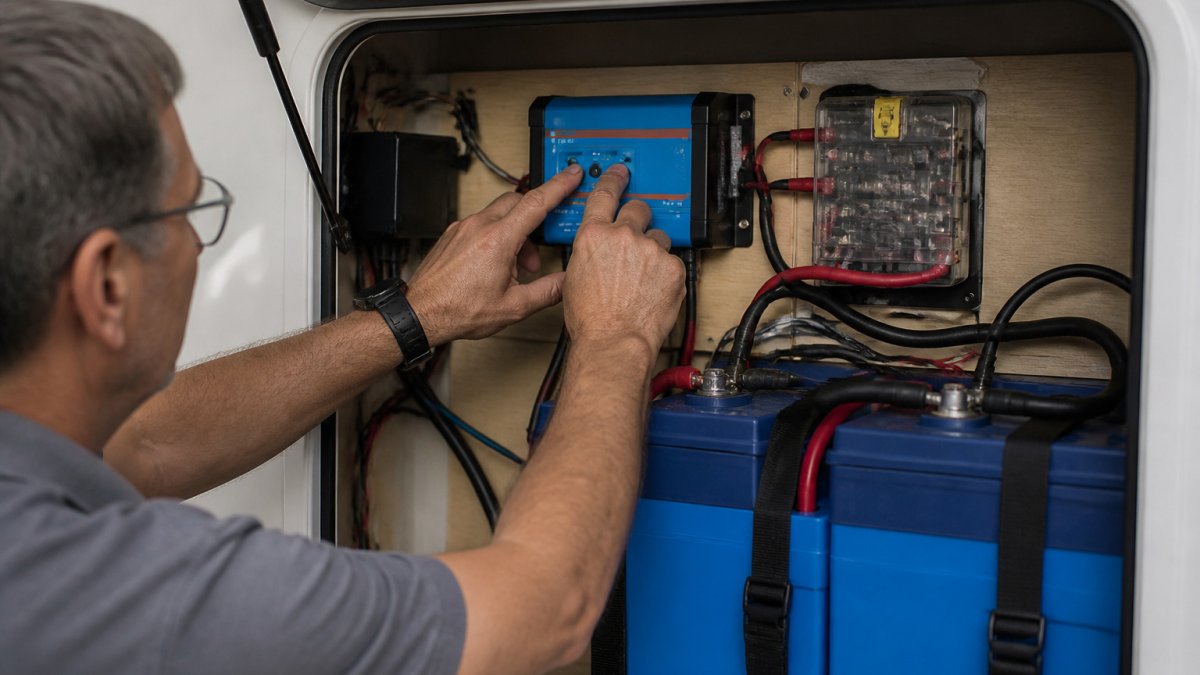
Match the controller's current rating to your array and battery. Pick the controller by the current it must handle, not the cheapest option that fits the wiring.
Once the controller is set, check that the BMS, controller and battery all agree on the voltages.
How Long Lithium Battery Charging Takes and What Changes It
Charge time depends on battery capacity, charge current and how much energy is missing. A 100-amp-hour battery charged at 50 amps from near empty needs roughly two hours in bulk alone, and the absorption stage adds more.
The biggest levers are charge current and the absorption setting. Higher current shortens bulk but generates more heat. Longer absorption fills the last few percent of capacity at the cost of time.
Cold Weather Charging, Temperature Limits and Troubleshooting Odd Behavior
Cold temperatures change what a lithium battery will accept, and the charger's behavior may not match what the battery's BMS allows. Here are actionable temperature thresholds, the risks, and a diagnostic framework for abnormal charging behavior.
Temperature thresholds for charging
Most lithium-ion cells, including LiFePO4, must not be charged below 32°F (0°C). Charging below freezing causes lithium plating on the anode, which permanently reduces capacity and raises the risk of internal short circuits.
Above 113°F (45°C), most manufacturers recommend reducing charge current or stopping charging entirely to avoid accelerated aging. The BMS in a quality lithium battery will have low- and high-temperature cut-offs, but the charger may not know about them.
BMS protection versus charger behavior
When a lithium battery stops accepting charge in the cold, the cause is usually one of two things: the BMS has opened the charge path (a protection event), or the charger has reduced or stopped output because it senses a low temperature. A BMS protection event shows in the app or display as a temperature fault or a charge MOSFET off state; a derated charger shows a lower current than expected but no fault. Check both before assuming the battery is defective.
Diagnosing abnormal charging behavior
Early voltage cutoff. The charger stops before the battery reaches full voltage.
Prolonged absorption. The charger holds absorption voltage far longer than expected, and current stays above the termination threshold.
Failure to reach full charge. The battery reaches absorption voltage but never tapers to the termination current.
BMS charge interruption. The BMS repeatedly interrupts charging, often cycling on and off.
Wiring and voltage drop
A thin cable or a long run can make the charger see a lower voltage than the battery actually holds, so the charger stays in bulk longer or never reaches absorption. Use a voltage drop calculator or measure under load. As a rule of thumb, keep voltage drop below 3 percent of system voltage. For a 12-volt system, that is about 0.36 volts; for a 48-volt system, about 1.44 volts.
Choosing a Charging Profile for Your Setup and Getting Help Configuring It
The right profile depends on the battery, the charger and how you use the system. A full-time RV with a large solar array and a boat with an alternator charger each need different current limits and absorption times.
If your setup mixes solar, an alternator and shore power, the profiles need to coordinate or the sources will fight each other. Victron Guy provides technical support by phone, text, email and in person.
Frequently Asked Questions
What is a lithium battery charging profile?
A lithium battery charging profile is the set of voltage and current rules a charger follows to fill a battery. It defines the bulk current, the absorption voltage and the point where charging ends. Matching the profile to the battery's data sheet protects the cells and preserves capacity.
What voltage should I charge a 12V LiFePO4 battery to?
A search-result summary gives 14.2 to 14.6 volts as the optimal charging range for a 12-volt lithium battery. Use the exact figure in your battery's data sheet, because that is the value the manufacturer validated.
Do lithium batteries need a float stage?
Most lithium batteries do not need a float stage and can be damaged by sitting at high voltage. Many profiles end after absorption or switch to storage mode. Check your battery's documentation before disabling float.
Can I charge a lithium battery in freezing temperatures?
Charging below freezing can cause lithium plating and permanent capacity loss. Check your battery's stated charging temperature range, and consider a heated battery for cold climates.
Why does my lithium battery stop charging before it is full?
A battery management system may have cut off charging because of a high-voltage cell, a temperature limit or an imbalanced pack. Check the BMS for a protection event and confirm the charger's voltage settings match the battery's requirements.
Frequently Asked Questions
What is a lithium battery charging profile?
A lithium battery charging profile is the set of voltage and current limits a charger follows while filling a battery. It defines how much current flows in each stage, the maximum voltage the charger applies, when charging ends and whether a float stage is used. Most lithium profiles are built around constant-current/constant-voltage (CC/CV) charging, which keeps cells within their safe voltage window. Matching the profile to your battery chemistry, typically LiFePO4, protects capacity and lifespan. Check your battery manufacturer's recommended settings before changing any value in your controller.
What voltage should I use to charge a LiFePO4 battery?
A typical 12-volt LiFePO4 absorption range is roughly 14.2 to 14.6 volts. Within that range, the exact target depends on the battery and its battery management system, and a high setting may push some cells upward and cause the BMS to stop charging. Use your battery maker's specifications, set your charger for a lithium profile, and avoid guessing. Scale the voltage for 24V and 48V banks accordingly.
Should a lithium battery charger have a float stage?
Not necessarily. Some charging profiles offer a storage mode, and whether it is needed depends on the battery and charger. Many lithium batteries, particularly LiFePO4, are commonly charged with a CC/CV profile that ends at full charge without a long float period. Whether a float stage is appropriate depends on the battery and the charger's settings, so confirm with the manufacturer. In systems that sit idle for long periods, a storage level setting may be more useful than continuous float charging.
Can I use a lead-acid charger to charge a lithium battery?
It depends on the charger. Lead-acid chargers often use voltage targets and float levels designed for lead chemistry, which may not match what a lithium battery needs. A charger with a dedicated lithium profile, or one whose voltage and charge-termination settings you can adjust, is the safer choice. Before connecting a lead-acid charger, check the maximum absorption voltage, float voltage and whether it can be disabled or reprogrammed. Mismatched settings can overcharge the battery or leave it undercharged, reducing its service life.
How long does it take to charge a lithium battery?
Charging time depends on battery capacity, charge current and the stage the battery is in when charging starts. A battery charged at a high current will reach the constant-voltage stage sooner, but the current then tapers as the battery nears full charge, so the final stretch can take noticeably longer. Starting from a low state of charge takes much longer than topping off a partly charged battery. Use your charger's current limit and the battery's capacity to estimate roughly how long a charge will take, then confirm with real measurements in your system.
Can you charge a lithium battery in cold weather?
Charging lithium batteries below freezing can cause lithium plating and permanent damage, so many batteries include low-temperature charge cutoffs or heater systems. Check your battery's documented charging temperature range before charging in cold conditions. Where a battery has built-in protection, the BMS may block charging until the cell temperature rises. Some systems use a temperature sensor on the battery to adjust charge voltage. If you camp or live where temperatures drop, plan to warm the battery or choose a model rated for cold charging.
How do I set a lithium battery charging profile in a solar charge controller?
Start by selecting a lithium or LiFePO4 preset in the controller, then review the bulk, absorption and float or storage values against your battery manufacturer's specifications. Set the absorption voltage, the charge current limit and the charge-termination behavior as directed. Confirm the battery voltage setting matches your bank, whether 12V, 24V or 48V. Save the profile, then monitor the first few charge cycles to check that voltage and current behave as expected. Contact technical support if the numbers in your manual do not match the controller's options.