 blog
7 Pure Sine Wave vs Modified Sine Wave Inverter Facts
Last Updated: November 2, 2026
Quick Summary
A pure sine wave inverter outputs a smooth, rounded waveform that mirrors utility power, while a modified sine wave inverter produces a stepped, blocky approximation. Pure sine power runs motors, compressors, and sensitive electronics cleanly, whereas stepped power makes them run hotter, hum, or fail early. When in doubt, size for pure sine.
- Modified sine inverters can post higher headline efficiency numbers at full load, but real-world results depend on the loads being run.
- A true sine wave has a crest factor of about 1.414, while a stepped waveform's peak-to-RMS relationship is different.
- Check the THD specification in the inverter's datasheet, since lower THD generally means cleaner output.
- Add the startup current of the largest motor load to everything else running at once to find your real surge requirement.
- Voltage sag under load can trip an inverter's low-voltage cutoff long before the battery is actually empty.
Table of Contents
- What the Output Waveform Actually Does to Your Gear
- Modified Sine Wave Inverter Compatibility: What Runs Fine and What Doesn't
- Appliances That Need a Pure Sine Wave Inverter
- Pure Sine Wave Inverter vs Modified Sine Wave Inverter Efficiency
- How to Check Whether a Device Needs Pure Sine Output
- How to Choose an Inverter for Solar, RV, and Marine Systems
- Sizing for Surge Power Before You Buy
- Matching an Inverter to Your Battery Bank With Expert Help
- Frequently Asked Questions
What the Output Waveform Actually Does to Your Gear
The shape of an inverter's AC output decides which devices run cleanly and which run hot, hum, or fail early. A pure sine wave inverter produces a smooth, rounded waveform that mirrors utility power, while a modified sine wave inverter outputs a stepped, blocky approximation. That difference changes how motors spin, how transformers heat up, and how sensitive electronics behave.
Smooth Sine Wave vs Stepped and Square Wave Output
A pure sine wave rises and falls in a continuous curve, matching the AC power your devices were designed to accept. A modified sine wave, sometimes called a simulated sine wave, jumps between voltage steps in a blocky pattern that only roughly resembles a sine wave.
The practical fallout shows up in three places:
- Motors and transformers run warmer and can rattle audibly on stepped power.
- Power supplies in laptops and chargers work harder to smooth the input.
- Sensitive electronics may glitch, buzz, or refuse to run at all.
New RVers often find that a cheap inverter works fine until a CPAP machine or espresso pump is added. Waveform quality is the reason.
Modified Sine Wave Inverter Compatibility: What Runs Fine and What Doesn't
Modified sine wave compatibility is broader than the internet suggests, but narrower than the price tag implies.
Here is how the split shakes out in practice:
| Device Type | Modified Sine Wave | Pure Sine Wave |
|---|---|---|
| Incandescent lights, heaters | Runs fine | Runs fine |
| Basic power tools | Usually fine, runs warmer | Clean operation |
| Older fridges and fans | Often works, audible hum | Quiet and efficient |
| Laptop and phone chargers | May buzz or overheat | Designed for it |
| CPAP machines, medical devices | Not recommended | Required |
| Microwaves with digital panels | Unreliable | Reliable |
| Laser printers, audio gear | Frequent faults | Clean output |
Modified sine wave inverters can still be practical for some applications, while pure sine wave models generally offer better compatibility with sensitive loads.
A common mistake is assuming a device that switches on will keep working. It might run for months on stepped power before a power supply fails.
Appliances That Need a Pure Sine Wave Inverter
Appliances that need a pure sine wave inverter are the ones with motors, compressors, digital logic, or heating elements that depend on clean AC power.
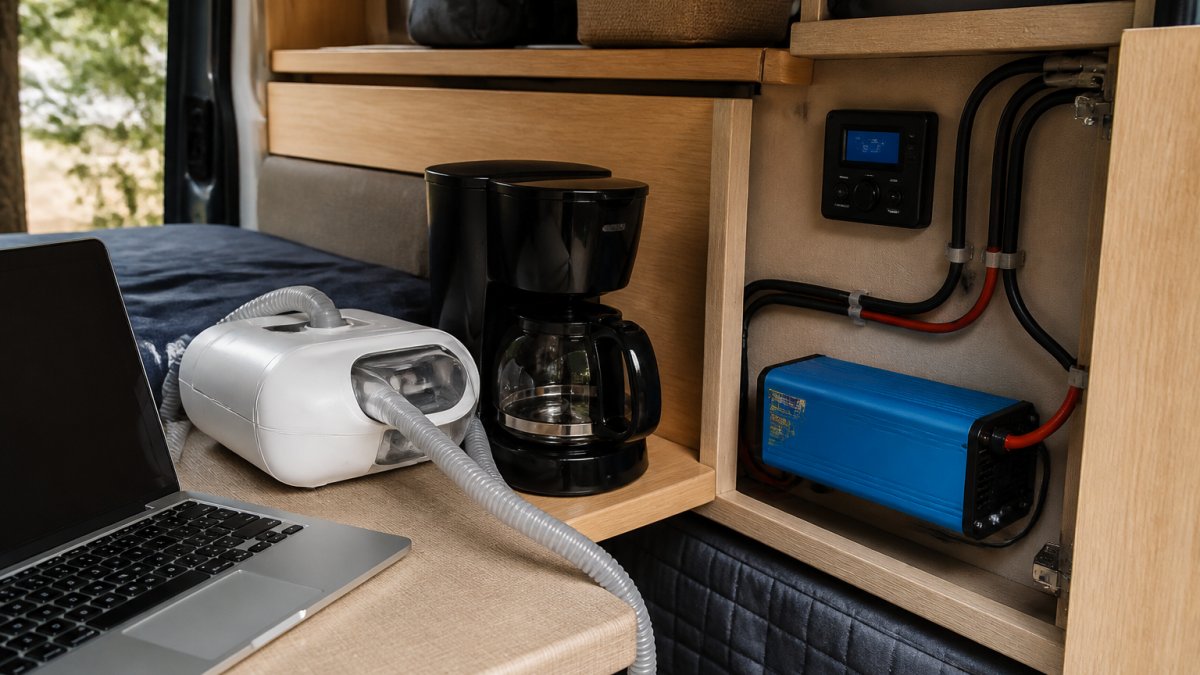
The list we see most often in mobile setups:
- Medical equipment such as CPAP and oxygen concentrators, where failure is not an inconvenience.
- Microwave ovens, especially inverter-style models with digital controls.
- Refrigerators and freezers with variable-speed compressors.
Watch out: running a compressor fridge on modified sine power can shorten the compressor's life without warning. It cools fine right up until it doesn't.
Pure Sine Wave Inverter vs Modified Sine Wave Inverter Efficiency
The pure sine wave inverter vs modified sine wave inverter efficiency question has a simple answer and a messy one. Modified sine units can post higher headline efficiency numbers at full load, but real-world results depend on the loads being run.
Why the Bench Number Misleads
Inverter efficiency is the ratio of AC watts out to DC watts in, almost always quoted at a single load point, usually 50% or 100% into a resistive load. A resistive load like a heater draws current in phase with voltage, so a stepped waveform delivers nearly the same power as a smooth one. That is why a modified sine inverter can look competitive on a spec sheet.
Motors, compressors, and transformer-based power supplies are not resistive. They respond to the shape of the waveform, not just its RMS value:
- Induction motors see the voltage steps as harmonic content. The extra harmonics produce counter-rotating magnetic fields that do no useful work but generate heat and audible hum, so the motor draws more current for the same shaft output.
- Transformer-based power supplies (heavy wall warts, microwave transformers, many audio supplies) saturate more readily on a stepped waveform, drawing current spikes at the step edges that the inverter must supply from the battery.
- Switch-mode power supplies in laptops and chargers are more forgiving because they rectify and re-filter the input, but cheap units with undersized input capacitors work harder and run warmer on stepped power.
The Specifications That Actually Predict Performance
Three numbers tell you more about real-world behavior than the headline efficiency rating:
- Total harmonic distortion (THD). Check the THD specification in the inverter's datasheet, since lower THD generally means cleaner output. A modified sine wave's stepped output is rich in odd harmonics, the 3rd, 5th, and 7th heat motors and buzz transformers. Lower THD means less wasted energy inside the load, not just inside the inverter.
- Crest factor. This is the ratio of peak voltage to RMS voltage. A true sine wave has a crest factor of about 1.414. A stepped waveform's peak-to-RMS relationship is different, and loads that rely on peak voltage, many power supplies do, behave differently as a result.
- Load-dependent efficiency curve. Ask for efficiency at 20%, 50%, and 100% load, not just one point. Inverters are usually least efficient at light load, and a modified sine unit's advantage at full load often evaporates at the partial loads that dominate real use.
What the Losses Look Like Over a Season
A cleaner waveform means less wasted energy in the device itself, not just in the inverter. A compressor fridge or microwave transformer running on stepped power converts some of that harmonic energy into heat, amp-hours pulled from your battery bank that never did useful work.
U.S. Department of Energy guidance on power electronics and inverter efficiency explains how load type affects real conversion losses, which is why bench ratings rarely match field performance.
How to Check Whether a Device Needs Pure Sine Output
You can check whether a device needs pure sine output by reading its label, identifying its power supply, and checking the manufacturer's documentation. Most cases settle in under five minutes.
Step 1: Read the Device Label and Power Supply
Start at the data plate or the wall adapter, not the marketing page.
- Look for the AC input spec. A label reading "100-240V AC, 50/60 Hz" tells you the device expects a clean sine input. A label that explicitly mentions "modified sine wave compatible" or "simulated sine wave OK" is the manufacturer telling you stepped power is acceptable.
- Identify the power supply type. A heavy, brick-style adapter is usually a transformer-based linear supply, these hum and run hot on stepped power. A light adapter is switch-mode, which rectifies and re-filters the input and is generally more tolerant, though cheap units with small input capacitors still struggle.
- Check for a motor or compressor. If the device moves something, a fan, a pump, a compressor, a spinning disk, it has an induction motor and will run warmer and louder on a stepped waveform.
Step 2: Classify the Load
Load type predicts tolerance better than brand or price:
- Resistive loads (heaters, incandescent lights, resistive cooktops) are forgiving. The waveform shape barely matters.
- Motor loads (fridges, fans, pumps, power tools) tolerate stepped power but pay for it in heat, hum, and shortened life.
- Transformer loads (microwave transformers, older audio gear, some battery chargers) are the least tolerant and the most likely to buzz or saturate.
Step 3: Check the Manufacturer's Documentation
The manual and the manufacturer's support page are the claim you can rely on if a device fails under warranty. Search the manual for "inverter," "modified sine," or "power quality." Some manufacturers state a minimum THD or require a pure sine source for warranty coverage. The FTC's consumer guidance on product specifications and labeling is a useful reminder that the written specification is the claim that holds up when you need recourse.
Step 4: Test and Listen
If you already have the device running on stepped power, watch for the telltales:
- Audible hum or buzz that is louder than on utility power.
- Excess heat from the device or its adapter after a short run.
- Clicks, glitches, or resets in devices with digital controls.
Any of these is the device telling you the waveform is costing it life. A device that switches on is not the same as a device that is happy.
When in doubt, size for pure sine. The cost difference is smaller than replacing a compressor.
How to Choose an Inverter for Solar, RV, and Marine Systems
Choosing an inverter for solar comes down to three decisions: waveform, continuous rating, and how the unit integrates with your charging system. Get the waveform right first, then size for the loads you will actually run.
For solar and off-grid systems, pure sine output is the standard choice because most household appliances assume it. RV power systems face the same logic, plus tighter space and ventilation constraints.
If you are weighing whether to combine charging and inverting in one unit, this comparison of an inverter charger vs standalone inverter walks through the trade-offs. For boat owners, our guide on why Victron is a trusted choice for marine power covers the reliability factors that matter offshore.
A practical selection checklist:
- List every device and its running wattage
- Note which devices have motors or compressors
- Confirm pure sine output for sensitive loads
Sizing for Surge Power Before You Buy
Add up running wattage first. Then add the startup current of the largest motor load to everything else running at the same time.
Our step-by-step walkthrough on RV inverter surge capacity shows how to work through those numbers for a typical mobile setup.
Watch out: undersizing for surge trips breakers and stresses the inverter every time a compressor kicks on.
Matching an Inverter to Your Battery Bank With Expert Help
Matching an inverter to a battery bank is where good intentions meet chemistry. The inverter must handle the bank's voltage, the bank must supply the current the inverter demands, and the charging side must keep both happy.
A lithium bank and a lead-acid bank behave differently under heavy draw.
A phone call can help you size and configure a system. If you want to see the components first, here is where you can buy Victron Energy components online.
Frequently Asked Questions
Can a modified sine wave inverter damage electronics?
It can shorten the life of some devices rather than destroy them outright. Motors run hotter, power supplies hum and waste energy, and sensitive electronics may glitch or fail early. Modified sine wave inverters can remain practical for basic loads, but pure sine wave models generally offer better compatibility. If your setup includes a laptop, medical device, or modern appliance with a digital control board, a sine wave inverter is the safer match.
Will a modified sine wave inverter run a refrigerator?
Often yes, but with caveats. A compressor fridge with a simple motor may start and run on modified sine output, though it will draw more current, run warmer, and hum louder. Fridges with digital controls, inverter compressors, or variable-speed motors usually need pure sine output. Check the appliance label for the startup current and confirm the inverter's surge rating covers it before you commit.
Are pure sine wave inverters more efficient?
Usually, yes, especially with motors, transformers, and power supplies. Clean sine output lets those loads run at their designed operating point instead of generating excess heat and audible hum. The gap is smallest with simple resistive loads like a heating element and largest with inductive loads. Efficiency also depends on load level, so a lightly loaded inverter of either type wastes proportionally more power.
How do I choose the right inverter for my solar system?
Start with your battery bank voltage and chemistry, then list every load and its startup current. Add up continuous wattage, then size the inverter so surge power covers the largest motor start. Choose pure sine wave if any load has a digital control board, motor, or medical function. Confirm the inverter's input range matches your battery and that its charger settings suit lithium or lead-acid. A dealer who knows your battery can walk you through the configuration.
The hard part of inverter selection is not reading a spec sheet. It is knowing which numbers on that sheet apply to your gear, your battery bank, and the way you actually travel. Victron Guy stocks batteries, solar charge controllers, inverters, and monitoring systems, and we help you match them before you buy rather than after something fails. Get started with Victron Guy and build a power system that holds up when you are far from a hookup.