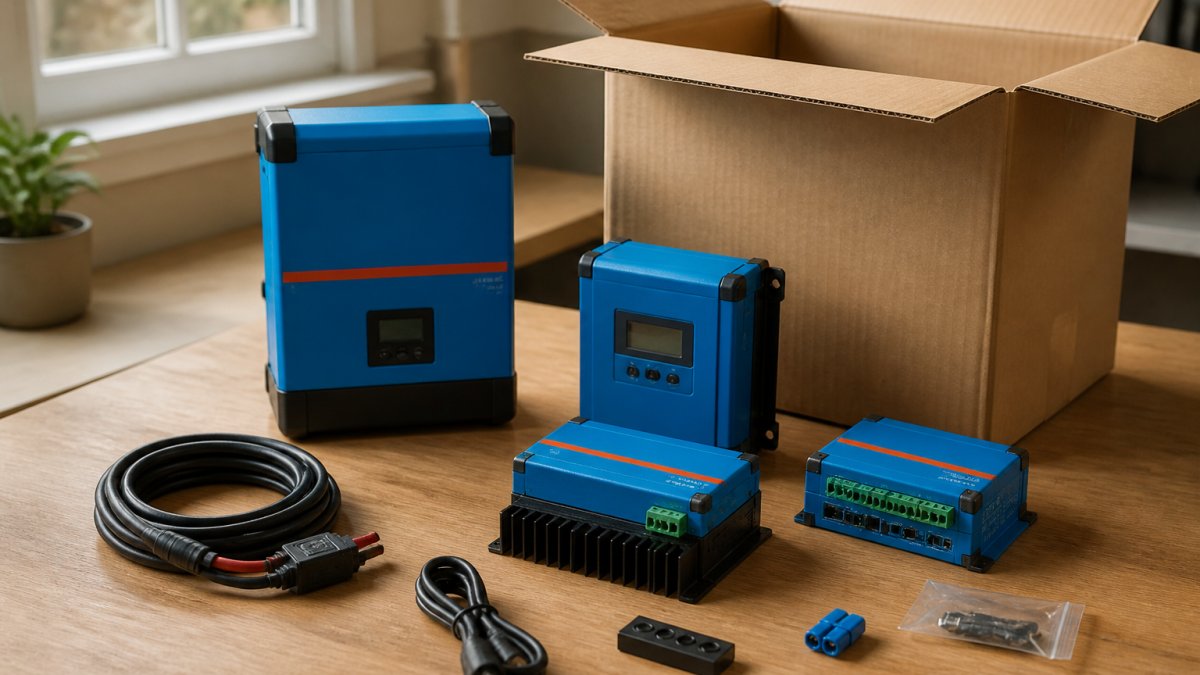
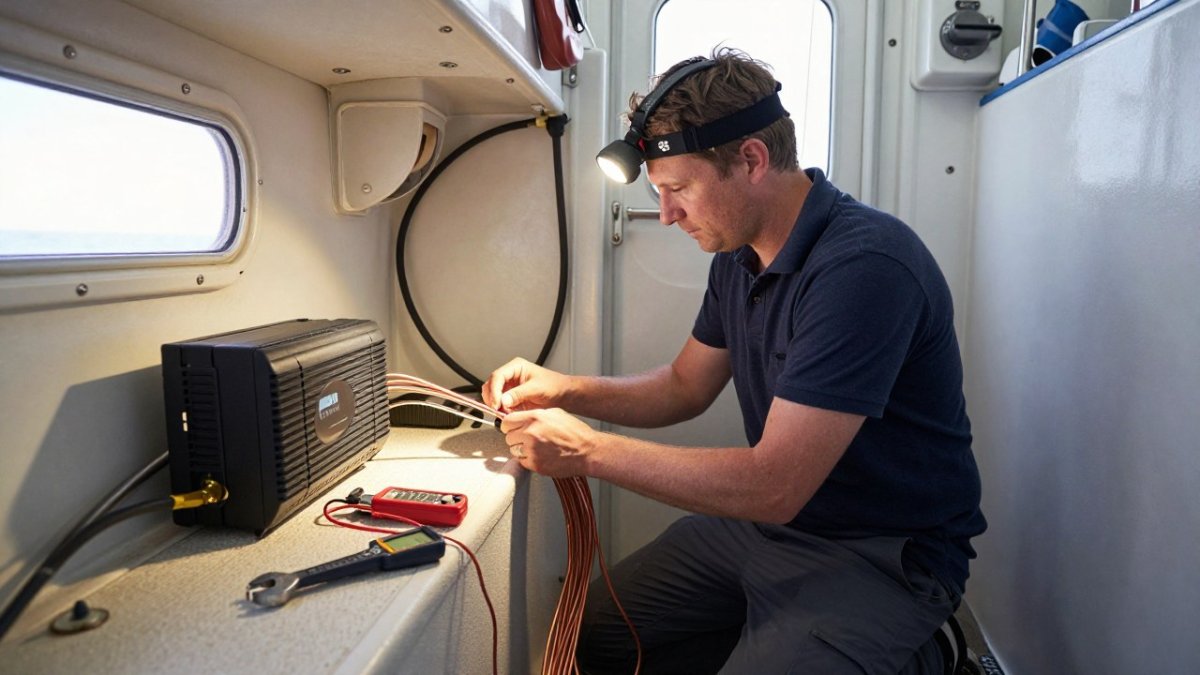
 Comparison
Do You Need a Pure Sine Wave Inverter for Marine AC?
Quick Summary
Yes, a pure sine wave marine inverter is usually the safer choice for a marine air conditioner, since its compressor is a motor that can run hotter, noisier or less efficiently on modified sine wave power. Size the inverter by the unit's startup surge as well as its continuous load, and check the manufacturer's installation manual for the required waveform.
- Motor-driven compressors can run hotter, noisier or less efficiently on modified sine wave power.
- Size the inverter for the startup surge, not just the running draw.
- A 500-watt inverter is usually too small for an air conditioner.
- Check the installation manual, since some manufacturers specify pure sine wave power.
- Use a realistic duty cycle when estimating battery runtime, not the best-case number.
Table of Contents
- How a Marine Inverter Runs an Air Conditioner
- Marine Inverter Size for Air Conditioner Loads
- Pure Sine Wave Inverter for Marine Air Conditioner: Is It Required?
- Marine Air Conditioner Battery Capacity and Runtime
- Marine Air Conditioner Inverter Installation Basics
- Comparing Inverter Options Available Today
- Get Your Marine Power System Sized Right
- Frequently Asked Questions
How a Marine Inverter Runs an Air Conditioner
Last Updated: November 7, 2026
A marine inverter converts the 12-volt, 24-volt or 48-volt DC power from your batteries into the AC power your air conditioner needs. Most modern marine air conditioners use an inverter-driven compressor, which adjusts its speed to match the cooling demand instead of switching fully on and off. That matters on a boat, where every amp drawn from the battery bank counts.
Inverter-driven air conditioners adjust compressor and fan speeds to match cooling demand, so the unit works harder only when the cabin needs it.
Marine air conditioning is sold in several configurations, and the right inverter depends on which one you choose. DC-powered units run straight from your battery bank, while AC units need an inverter to convert battery power. Victron Guy is an authorized Victron Energy dealer, and our team can help you match an inverter to the system you plan to run.
Inverter-Driven vs. Conventional Compressor Systems
Conventional compressors run at a fixed speed. They pull a large surge of current when they start, then cycle on and off to hold temperature. Inverter-driven compressors ramp up gradually and run at a lower steady draw once the cabin reaches its set point.
For an inverter, this difference is significant. A fixed-speed unit can demand a high startup load that a small inverter cannot supply. A variable-speed unit typically runs with a smoother, more predictable load, which makes it easier to size an inverter and battery bank around it.
Marine Inverter Size for Air Conditioner Loads
Choosing the right inverter comes down to two numbers: the continuous power your air conditioner draws while running, and the surge it needs to start. Check the nameplate or data sheet for both before you shop.
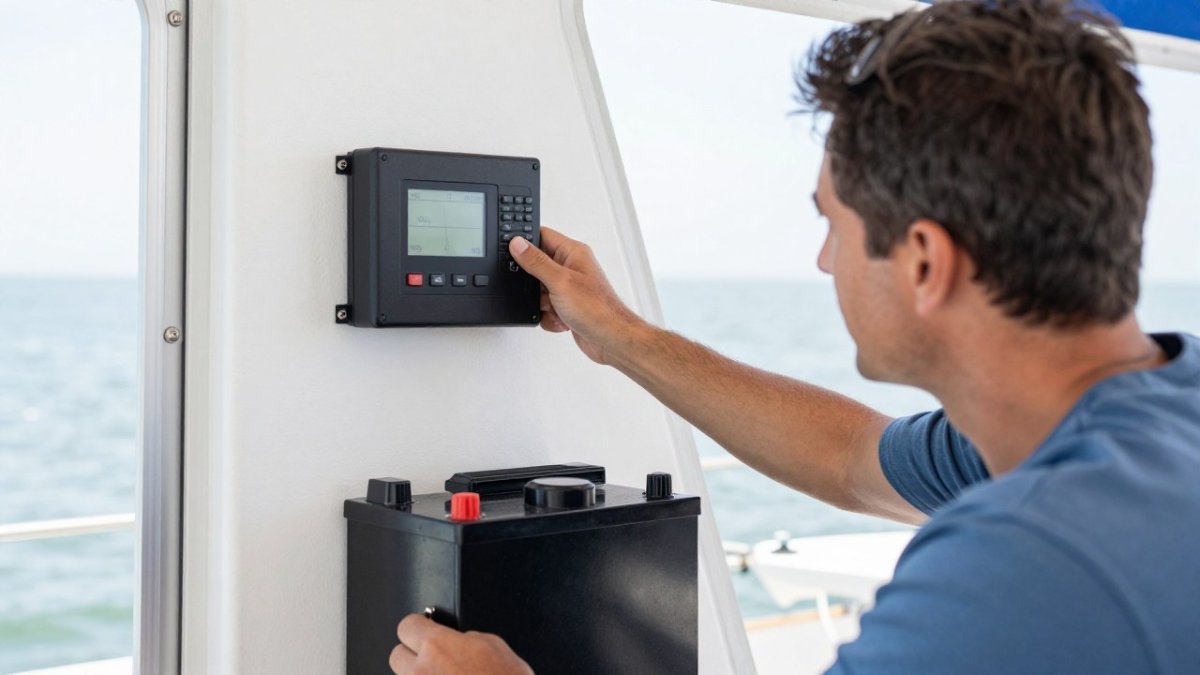
Inverters are available in many output sizes. Confirm the continuous and surge ratings against your specific air conditioner and inverter before buying, because listing excerpts rarely show the full picture.
Plan your loads before you pick a size.
Starting Surge and Continuous Load
Surge is the short burst of power a motor draws at startup. Continuous load is what the unit draws once it is running. An inverter must handle both. If the surge rating is too low, the inverter shuts down or the compressor fails to start, even when the continuous rating looks sufficient on paper.
Size for the surge, not just the running draw. Step-by-step method for calculating surge capacity walks through the calculation. Review the surge rating on the inverter data sheet and compare it directly to the air conditioner's startup requirement.
Pure Sine Wave Inverter for Marine Air Conditioner: Is It Required?
Pure sine wave output produces a clean AC waveform, similar to shore power. For a fuller side-by-side of pure versus modified output, see that comparison. Modified sine wave inverters produce a stepped approximation. Many electronics tolerate modified sine wave power, but motor-driven loads, including compressors, can run hotter, noisier or less efficiently on it.
For most marine air conditioners, a pure sine wave inverter is the safer choice. Check your air conditioner's installation manual, since some manufacturers specify pure sine wave power. A 500-watt inverter is usually too small for an air conditioner. Match the waveform and the wattage together.
Marine Air Conditioner Battery Capacity and Runtime
Battery capacity determines how long your air conditioner can run without a generator or shore power, but the number on the battery label is not the number you can use. Start with the amp-hour rating and nominal voltage of the bank, convert that to watt-hours, then apply three derating factors: usable depth of discharge, inverter efficiency, and compressor duty cycle.
Usable depth of discharge depends on chemistry. A flooded lead-acid bank is typically limited to about 50% depth of discharge to preserve cycle life, AGM is often treated similarly, and lithium iron phosphate (LiFePO4) banks commonly allow 80% to 90% usable capacity when paired with a battery management system. That difference alone can nearly double the usable energy from the same nominal amp-hour rating.
Inverter efficiency is the second factor. A pure sine wave inverter typically converts DC to AC at roughly 85% to 93% efficiency depending on load, and efficiency drops when the inverter is lightly loaded.
Duty cycle is the third factor and the one most often ignored. A variable-speed compressor does not draw its rated current continuously; it modulates. In a well-insulated cabin on a moderate day, the compressor may average 40% to 60% of its rated draw over an hour. In a hot, humid cabin with poor insulation or frequent door openings, that average can climb toward 80% or more.
Worked Runtime Example on a Lithium Bank
Suppose your air conditioner draws 1,000 watts while the compressor is running, and your system has a 24-volt, 400 amp-hour LiFePO4 bank. Nominal stored energy is 24 volts times 400 amp-hours, or 9,600 watt-hours. At 90% usable depth of discharge, usable energy is about 8,640 watt-hours. Apply 90% inverter efficiency and usable AC energy is about 7,776 watt-hours. If the compressor averages a 50% duty cycle over the cooling period, the effective average draw is 500 watts, and runtime is about 15.5 hours. If the duty cycle rises to 80% on a hot day, the average draw is 800 watts and runtime falls to about 9.7 hours.
Watch out: battery discharge limits can cap runtime before energy does. A lithium bank with a 100-amp continuous discharge limit at 24 volts can deliver 2,400 watts, which is ample for a 1,000-watt air conditioner plus inverter losses, but a smaller or older bank may not. Check the continuous discharge rating, not just the amp-hour capacity.
Charging capacity closes the loop. If you run the air conditioner for 10 hours overnight and draw roughly 5,000 to 8,000 watt-hours, you need charging sources that can replace that energy during the day. Alternator output, solar wattage, and shore power charging all matter. A common pattern is that the battery bank is sized for one overnight cycle, and the charging system is sized to refill it in a reasonable fraction of the next day. Plan both together, and leave a margin for cloudy days and degraded battery capacity over time.
Marine Air Conditioner Inverter Installation Basics
Good installation protects the inverter, the batteries and the wiring. Mount the inverter in a dry, ventilated spot close to the battery bank to keep DC cable runs short. Size the cables for the inverter's maximum current draw, and fuse each positive line close to the battery.
Ground the system according to the manufacturer's instructions and your local marine electrical standards. Provide adequate ventilation around the inverter, since heat reduces its output and lifespan. If you are unsure about any step, ask a qualified marine electrician to review the design before you power it up.
Comparing Inverter Options Available Today
Before comparing models, clarify a terminology trap that blurs most search results. Deciding between an inverter charger and a standalone inverter is the first choice to make for your system. First, a marine inverter is a device that converts battery DC into AC power for an AC air conditioner. Second, an inverter-driven compressor is a variable-speed compressor that adjusts its own speed to match cooling demand.
With that clear, size the inverter from the air conditioner nameplate and data sheet. You need four numbers: continuous running watts, startup surge watts, power factor, and system voltage. Continuous watts set the inverter's continuous rating.
Cable losses and battery discharge limits belong in the same calculation. A 24-volt inverter drawing 2,000 watts pulls roughly 83 amps before efficiency losses, and a long, undersized DC cable run can drop enough voltage to cause nuisance low-voltage shutdowns. Keep cable runs short, size conductors for the maximum current, and fuse each positive line close to the battery.
The table below compares representative options by output class and role, not by price, because pricing varies by retailer and configuration and should be confirmed directly.
| Option | Output class | Role and notes |
|---|---|---|
| Mastervolt MS2000 | 2,000 W continuous, 4,000 W peak reported | Inverter-charger; combines inversion and battery charging in one unit, which simplifies shore-power integration |
| Renogy 2000W Pure Sine Wave Inverter | 2,000 W, pure sine | Standalone inverter for mid-size loads; confirm surge rating against your compressor startup |
| BESTEK 500W Pure Sine Wave Power Inverter | 500 W, pure sine, 12 V input | Too small for most air conditioners; useful only for small DC loads or electronics |
| Victron Phoenix 24/800 | 800 W, 24 V | Compact option for smaller or highly efficient variable-speed units |
Match the waveform and the wattage together. Most marine air conditioners specify pure sine wave power because motor-driven compressors can run hotter and noisier on modified sine wave output. Check the installation manual for the manufacturer's requirement rather than assuming.
Total installed cost matters more than unit price. Add the cost of marine-rated cable, fuses, breakers, mounting, and any remote panel, then compare that total against a generator alternative. A generator adds fuel, maintenance, noise, and exhaust considerations. The right choice depends on how often you cool at anchor versus at a dock with shore power.
Watch out: mixing battery chemistries or charging sources without a compatible charge profile can damage a lithium bank or leave a lead-acid bank undercharged. Confirm the inverter-charger's charge profiles match your battery chemistry, and verify that solar, alternator, and shore power charging all use compatible settings.
Get Your Marine Power System Sized Right
Sizing a marine inverter for an air conditioner means checking surge, continuous load, waveform and battery capacity together. Get those four right and the rest of the system falls into place.
Ready to plan your setup? Victron Guy's team can review your air conditioner's specifications and help you plan an inverter and battery configuration that fits your boat. Contact us for a quote, since pricing depends on quantity, dates, and delivery.
Frequently Asked Questions
What size inverter do you need to run an air conditioner?
Size the inverter to the air conditioner's running wattage and its startup surge, not just the BTU rating. Check the nameplate or manufacturer data for both figures. Many marine units start with a surge several times their running draw, so an inverter rated only for continuous load can shut down at startup. Add a margin for other loads running at the same time, such as a refrigerator or water pump, and confirm the inverter's surge rating covers the largest single start.
Can a marine inverter run a boat air conditioner?
Yes, a marine inverter can run a boat air conditioner if its continuous rating and surge capacity match the unit's requirements. Battery-powered inverter systems can cover limited periods of cooling, but running an air conditioner overnight at anchor usually requires a generator or a large lithium battery bank with charging capacity. Confirm the system voltage, which may be 12V, 24V, 48V, 120V or 230V, before buying equipment.
Does a marine air conditioner require a pure sine wave inverter?
Many manufacturers recommend a pure sine wave inverter for air conditioners because compressors and motors run more efficiently and with less stress on pure sine output. Modified sine wave units may work with some loads but can cause noise, overheating or reduced compressor life. Check the air conditioner's installation manual for the required waveform before buying an inverter.
How much battery capacity does a marine air conditioner need?
Battery capacity depends on the air conditioner's running draw, how many hours you plan to run it, and the usable capacity of your battery bank. Lithium batteries typically allow a larger share of their rated capacity to be used than lead-acid batteries. Divide the amp-hours you need by the usable capacity, then add margin for inverter losses. Victron Guy can help you work through the numbers for your specific boat, and pricing depends on quantity, dates and delivery, so check the website for current prices or request a quote.